Q17 V79 states that “And from [part of] the night, (taHajjad) ‘pray’ with it as (nafilatan) ‘additional [worship]’ (llaka) ‘for you’, it is expected that your Lord will (yab a’thak) ‘resurrect’ you to a (maqama mmahmudan) ‘praised station’.”
In deciphering what this verse is really about, one has to deeply understand a handful of key words. And the first one I will like for us to look into it ‘nafilatan’. 2 variations of the word was used in the Quran, each one twice; nafilatan, and anfal. And despite the fact that the former has been popularly understood to mean voluntary or supererogatory prayers and the latter to mean spoils of war, at their core, what these words really mean is ‘gift’, a reward for doing something, or something given or done for one doing something.
In Q21 V72, Allah said, “And We gave him Isaac and Jacob in (nafilatan) ‘addition’, and all [of them] We made righteous.” So, we see that nafilatan was used here to qualify the grandchild of IbraHeem, ya’qub (Jacob). We can’t say Jacob is a ‘voluntary prayer’ now, can we? But what this tells us is that Jacob was given to IbraHeem as a grandchild in addition to Ishaq (Isaac), as a gift. Allah could have decided to make the next prophet after Isaac take some hundreds of years, but as a reward for IbraHeem’s steadfastness, Allah bestowed upon him a nafilatan, one in form of a human being.
Now that we know this, let’s move to the second of three places the word was used; Q8 V1. Allah said that “They ask you, [O Muhammad], about the (anfal) ‘bounties [of war]’. Say, ‘The [decision concerning] (anfal) ‘bounties’ is for Allah and the Messenger.’” Obviously, spoils or bounties of war, anfal, which also happens to be the title of this chapter, is a reward gotten after an opposing side has been defeated, this gift, if you will.
So the pattern we see is that after something has been done or given, nafilatan is what comes after. And this takes us to the verse at hand. Q17 V79 says that “And from [part of] the night, pray with it as (nafilatan) ‘additional’ [worship] for you; it is expected that your Lord will resurrect you to a praised station.”
We see clearly here, that the chain of ‘reward’ theme is unbroken. The question then is, what is this nafilatan a reward of? What came before it? The verse before it, V78 has the answer. V78 of Q17 says that “Establish prayer at the decline of the sun [from its meridian] until the darkness of the night and also] the Qur’an of dawn. Indeed, the recitation of dawn is ever witnessed.”
‘At the decline of the sun [from its meridian]’ is said to be Zuhr and A’sr, while ‘until the darkness of the night’ refers to Magrib and I’sha, and ‘the Qur’an of dawn’ is the fajr prayer. So, we see that the previous verse basically is the 5 daily prayers, and that is what ‘taHajjud’ is nafilatan to.
Now, I know, you have the questions, like, how is the gift something you do? Shouldn’t it flow naturally from having done something?
The first lesson one derives from this is that the gift of solat is taHajjud, it is the reward one gets after having done the solat, and it naturally flows, so that it’s not even a bother. And for those that observe them, it soothes and pleases them just as the victors are pleased at the sight of spoils of war. For these folks, they see it, not as something they ‘do’, but as a gift or reward that needs to be ‘picked up’ and enjoyed, just as the warrior would pick up the spoils of war, or IbraHeem would pick up his grandchild. In other words, the ‘picking up’ is not a chore once the gift has been given. Allahu Akbar!
I pray Allah bestows us, our families and friends the nafilatan of taHajjud. Amin.
Another interesting thing that can easily be missed is that, in the 3 places where Allah mentions nafilatan or its other form, anfal, solat is mentioned with it; whether in the case of spoils of war, or the grandchild of IbraHeem.
We’ve seen that of Q17 Vs 78 and 79.
In Q21 V72, Allah said ‘And We gave him Isaac and Jacob in addition, and all [of them] We made righteous.’, V73 that follows states that “And We made them leaders guiding by Our command. And We inspired to them the doing of good deeds, establishment of (solat) ‘prayer’, and giving of zakah; and they were worshippers of Us.”
And in Q8 V1, Allah says that “They ask you, [O Muhammad], about the bounties [of war]. Say, “The [decision concerning] bounties is for Allah and the Messenger.” So fear Allah and amend that which is between you and obey Allah and His Messenger, if you should be believers.”, V2 continues by stating the qualities of this said believer when it says ‘The believers are only those who, when Allah is mentioned, their hearts become fearful, and when His verses are recited to them, it increases them in faith; and upon their Lord they rely.’ So while V2 talks about the state of their heart, V3 gives more outward expression of their faith when it says ‘ The ones who establish (solat) ‘prayer’, and from what We have provided them, they spend.”
So we see that there is a constant link between nafilat and solat, which further shows that the former is a reward of the latter. In fact, one can perhaps say that every mention of the injunction to pray the 5 times daily prayer, solat, is an injunction to pray taHajjud too, right? While it may seem far fetched; but, if we take into consideration the fact that taHajjud has been said to be the nafilatan of solat, it should automatically flow just as spoils of war is an automatic consequence of winning a war, except of course, if one hasn’t or didn’t win the war: may Allah make us victors. Amin. May Allah make us victors every day of our lives, and may the expression of this victory manifest itself in our observing the taHajjud every night. Amin.
i.

or, is there a victor
that lets anything
hold him back
from reaping
the fruit
of his
labor?

ii.

is there a victor
that leaves the battlefield
without claiming his treasures?

is he a true victor?

does a true victor leave
his hard gotten treasures
for someone else to claim?

iii.

what a strange victor that is;

for his spoils, his spoils of war,
can only make him stronger;
more generous, more gracious,
more protected, more grand;

just as his nafilatan can only
beautify his faith, his soul.

iv.

oh victors,
do you sleep
while your spoils
lie unattended
in the vastness
of the night?

do you?

v.

oh victors,
do you sleep sound,
dream even, while your
spoils of war lie uncollected,
unbatered, unused, throughout
the night on unknown lands
amidst strange elements?

vi.

oh victors, do not
let sleep deprive you
of enriching your soul
with the spoils of a war
you won square and fair;
before the break of dawn,
and another war begins.

vii.

shouldn’t you repurpose
the spoils from the previous
night for the wars of the next day?

shouldn’t you?

shouldn’t you fill your days
daydreaming on how to
administer the spoils?

viii.

the longer you are awake,
thick in the night, vic,
repeating the words
of the creator of the worlds;

the more you enrich yourself,
protect yourself, and the more
you get stronger for the wars ahead.

ix.

look forward to it, knights,
look forward to witnessing it;

just as much as a parent looks
forward to meeting their grandchild;

prepare all day, so that as soon as
the bearer of good news shows up;

after the yawns and stretches:

x.

you are quick to forward
your pretty gender neutral onesies
that would match the new soul
that has come forth,
the one that’s about to roam
the night, elated, euphoric,
ecstatic, collecting her spoils.

xi.

look forward to it victors,
for the night is undisturbed,
and if you don’t claim your spoils,
your enemies will, and enemies,
if you know anything about them,
it is that they will not hesitate
to use your spoils against you;

xii.

all is fair,
as they say,
in war and love;

oh noble souls,
long to love
your nafilatan,
your spoils of war.
Let’s see, we’ll title it ‘nafilatan nights’. 😁 The words of Allah as we recite them during the nafilatan, the reminders, the admonitions in them, are indeed enough treasures, for a mind eager to learn.
Here, now, we are tasked with proving that nafilat is the true name of taHajjud, and that taHajjud, and any other name for the night prayer like qiyamu layl, tarawih, shafi’ and witr, are words that describes nafilat. The similitude is that of a ‘gift’ that’s being described as standing, leaning, multiple or single, all of which truly describes the position the gift is in, or the amount of it there are, but which doesn’t deprive the gift of its essence of being a gift.
It is with this in mind, that we continue our journey through Q17 V79, which states that, “And from [part of] the night, (taHajjad) ‘pray’ with it as (nafilatan) ‘additional [worship]’ (llaka) ‘for you’, it is expected that your Lord will (yab a’thak) ‘resurrect’ you to a (maqama mmahmudan) ‘praised station’.”
So, here, Allah is saying to do taHajjud, to give one’s self that gift, so that perhaps, because one does taHajjud, one may be resurrected (yab a’thak) to a praised station (maqama mmahmudan). So, what is taHajjud? What does it entail?
The word is derived from Ha, Jim and dal. The ta is a prefix that emphasizes the Hajada, just as the ta in taLlahi when one swears by Allah. Or the ta in tasbih (sabaha), taslim (salama), tasjud (sajada). In each place that ta prefixes a word, an emphasis is going on; God is saying ‘especially’, ‘particularly’, ‘zero in on this word’, and the likes, in those verses.
Anyway, back to Hajada; this verse is the only time it was mentioned in the Quran, no other variations of the word was used. And it is said to mean sleeping in the night or in the latter part of the night; to stay awake at night; (of a camel) to rest the fore part of the neck upon the ground.
Just as you may already know that Arabic has different words for animals whilst they are in different positions, especially with the camel. You know, just as ‘barak’ is said of the camel when it sits – when they take a rest during their journey, they’d make them sit around their temporary settlement for protection, and that’s how the word ‘barrack’ in the ‘military barracks’ evolved to be used as so, from the camel sitting, barak style.
And as for how the word barak came to be translated to ‘blessings’; that is because when a Barak (barrack) is created, everyone is able to go about their business as usual without fear of harm, Modern Arabic then started to refer to this ‘security system’ as a ‘blessing’, because to have it meant security, peace of mind, and the likes. And you’ll find that in duas, it comes in the latter part, and that’s because it is only when one has something, that they need protection around it; Allah’s protection this time around. An example is in our daily sayings of ‘Assallamu A’laikum Warahmatullahi Wabarakatuh’, so you see that the greeter prays that Allah’s peace and mercies be upon you first before ending it with ‘barak’. And that’s why saying the full dua should be practised more often instead of shortening it therefore depriving the recipient an important aspect of the prayer. May Allah make it easy. Amin.
I’m reminded of Utaybah, son of Abu Lahab, the same Abu Lahab that Suratul Masad cursed, who after divorcing one of the prophet’s daughter before consummation, rebuking Islam in a grandiose embarrassing way, tore the prophet’s cloths and spat on him; the prophet pbuh then prayed that one of Allah’s dogs should deal with him. Utaybah would have to travel northwards to Syria for a trade expedition soon after, so his father, Abu Lahab, told those that will be in his company to make sure that they arrange a strong ‘barak’ for Utaybah because of the prayer of the prophet pbuh. Fast forward, they did as was told while they were on the journey, only to wake up one day, and a beast of burden had scaled the barak, torn him to pieces and devoured him; just him. Anyway, I digress, thought I’d write one or two things about the word since it’s an integral word in the daily lives of the Muslims.
Back to Hajad, Hajad is what is said of the camel when the camel rests the fore part of its neck on the ground. And for context, these are some pictures of the camel when it does Hajad:

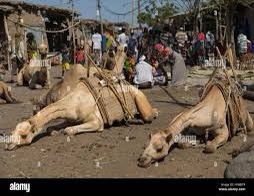


And without me stating the obvious, you can see that there is an eerie similarity between their state and when we prostrate, right? So that in Classical Arabic times, when they said someone was in a position of Hajad, this was what was understood. Just as in english when one’s physical position is likened to that of a cat when it stretches, lies on its back, tries to scare one off and the list goes on.
One might ask, why wasn’t a variation of the word sujud used? So that we have something like tasjud? But what Hajad has that sujud doesn’t have is the ‘sleepiness’ or ‘exhaustion’ that’s attached to Hajad. The camel does that position sometimes when it wants to sleep, just as we see above that Hajad also means ‘sleeping in the night or in the latter part of the night’. Whereas sujud doesn’t have such somnial quality. Sajda is mostly said when the camel bows for its rider to get on board. Sajda is also said of a ripe fruit when it hangs low out of heaviness. 8 forms of the word sajda was used 90 times in the Quran.
Despite the fact that Sujud was used in the Quran when Allah told the angels to prostrate to Adam as seen in Q7 V11; and that the plants and trees prostrate to Allah as seen in Q55 V6; and that all that’s in the heavens and the earth, and their shadows, prostrate to Allah as seen in Q16 Vs 48 and V49; and in Q76 V26, where Allah said, “And during the night prostrate thyself before Him,
and extol His glory for a long part of the night.” in which sujud was used for the prostration that happens in the night; what Hajad takes into consideration, especially in this verse, where a huge reward accompanied its mentioned, is the sleepiness and or exhaustion involved.
So that Allah is saying that ‘maqama mmahmudan’ is for those that do taHajjud despite how sleepy or tired their body gets during it. This does not mean that one must feel sleepy or tired to get the maqama mmahmudan, but with the use of taHajjud, and not tasjud, it is implied that Allah acknowledges the drowsiness that threatens to steal one away from the nafilat. Allah is acknowledging even those nights that are hard, and adding them to the mix. So that we don’t think that those hard nights doesn’t count. So that we don’t give up on those hard nights and decide to stop, and sleep instead. So that we know to hold steadfast, despite the drowsiness that’s waging its war, we keep at it, and InshaAllah, we’ll get to the other side if we hold steadfast, and do not give in to the pressure.
Especially when one takes into consideration Q73 V20 wherein Allah basically acknowledges that the prophet pbuh wakes up to pray almost two-thirds of the night, half of the night and sometimes a third of the night. Which if we put into perspective, if the night is 8 hours; ‘almost two-thirds of the night’ is more than 5 hours of taHajjud, definitely, drowsiness will try to steal one away. A lot of us can barely stay awake for an hour, 5 hours?! 😳 A word that takes that into consideration is definitely an added booster. So, despite the sleepiness, if any, hold your ground, don’t despair, the reward is grand.
I should do a series on how to ease the taHajjud process. InshaAllah. 🤞🏿
But why the prostration? Why didn’t Allah mention another word that takes into consideration the sleepiness one will feel standing for those hours, or bowing for those hours?
Despite the fact that it is easier to fall asleep, literally fall asleep, while prostrating, and even lose count of one’s words: I think if we take into consideration the words we say during prostration, and how that ties into the metaphorical meaning of the position we are in, when all of that is coupled with the specific reward mentioned; one easily sees why.
So, we say, subhana rabbiyal a’la, right? Which loosely means ‘Glory be to my Lord, the Most High’; so that when we are at our lowest, with our palms on the ground, the highest part of our body, our head, touching the floor, the lowest there is, we acknowledge the ‘Most High’.
Now, is it a coincidence that the reward mentioned has something to do with a ‘praised position’? So that because we debased our ‘highest’ to the ‘lowest’, we will be rewarded with being ‘raised’ to a ‘praised position’ on the day of judgment, a position that raises one high.
A’la, its root alphabets are ain, lam and waw, and 14 variations of the word was used 70 times in the Quran. And it is used to mean height, the top, exaltation, loftiness, honour, grandeur, to rise, to ascend, to tower, to mount, to overcome, to be arrogant, to be proud, pride, notables, and the likes. So that really, when we say those words whilst prostrating, it’s as much humbling, as it is an acknowledgment that Allah is the Highest, and no one can make one high but Allah.
But before we look into how acknowledging the Most High, while we are at our lowest ties with maqama mmahmudan; it is pertinent here, to give voice to ‘yab-a’thak’ (resurrect).
Yab a’thak is derived from ba-a’th, with ba, ain and tha as its root alphabets, and 6 variations of the word was used a total of 66 times in the Quran.
In Q6 V60, Allah said, “And it is He who takes your souls by night and knows what you have committed by day. Then He ‘yab-a’thukum’ (revives) you therein that a specified term may be fulfilled…” So, there, Allah is saying the process of waking up every morning when we wake, is a ba-a’th. And what we find is that, with ba-a’th doubling down on the theme of ‘sleepiness’, it further reinforces the argument that I’ve put forward about ‘taHajjud’ and the ‘sleepiness’ it acknowledges.
In Q18, Suratul Kahf, where Allah talks about those that slept in the cave for over 300 years; Allah says in Vs12 and 19 that, ‘ba-a’thnaHum’ (We awakened them); and in V19, Allah says, ‘waHum ruqud’ (they were asleep).
And, again, what all of these shows is that despite the fact that ba-a’th in Q17 V79 that we are studying is translated to resurrect, the word is also used for being ‘woken up’. Allah is saying Gẹ will wake us up from our taHajjud, from humbling the topmost part of our body to the earth beneath our feet, to the maqama mmahmudan. Allahu Akbar!
Only the speech of the Creator of the heavens and all that’s beneath it is able to flow like this. Oh Allah, I bear witness that there is no god but You, Allah, the creator and sustainer of all there is; and please, count me, accept me, my spouse, children, parents, siblings and friends as part of those who submit to you wholeheartedly, and resurrect us oh Allah, amongst your i’badika solihin, and let us all enter aljanatul firdaus on that certain day without reckoning, and without the fire touching us. Amin, thumma Amin.
I hope you see now, that taHajjud is the word that perfectly fits into this verse; if tasjud had been used, it will not include those tired nights; and if a word that acknowledges the ‘standing tired nights’ had been used in this verse, it won’t flow with ba-a’th that as we’ve seen means to wake or rise from one’s sleep, and again, of course, it won’t flow with maqama mmahmudan, a praised position. The whole of idea of rising from one’s prostration into maqama mmahmudan will be lost; the guy is already standing, to be raised, to rise, you have to be prostrating. And of course bowing won’t suffice because one is still kind of standing; but prostration all the way, now, one can be raised.
And it is with this that the maqama mmahmudan reward is attached. So, our next task is to look into what those words mean.
Maqam is one of the variations of the word qawam, with qaf, waw and mim as its root alphabets. Qawam, briefly, means to stand or rise. 25 variation of words evolved from this root, and we’ll be getting into more details when we get to Qiyamu Layl, InshaAllah, but for now, it’s safe to know that maqam is one of those words that are derived from it. With maqam, the mim is prefixed to it, just as the mim in mmahmudan, the next word is prefixed to it, being a conjunctive pronoun that it is.
With mahmud, the root alphabets are ha, mim and dal, and 7 forms of the word was used 68 times in the Quran. Hamd is said to mean praise, praiseworthy, to commend, to find to be praiseworthy.
So that when both words are being put side by side, which so happens to be the only place in the whole Quran where that was done, we have maqama mmahmudan, a praised, praiseworthy, commendable position – what Q44 V51 describes as maqama amin, the secure and safe place.
Have I mentioned that Q17, the surah that started all of these, that has this verse on being raised to a praised position from a prostration despite the tiredness one feels, is no other than suratul Isra? This is where I wait for you to flip the tables. 😀 The surah that told us about the prophet pbuh being raised to the heavens, in the night, while he slept, the ascension. Seeing the parallels, already? 😁 Also, have you noticed that mahmud is a variation of Muhammad? Both derived from prefixing mim to hamd. And we know that it was on this mission that he pbuh got the solat from Allah; so, with maqama mmahmudan, we are going to be in the company of our beloved prophet Muhammad pbuh. InshaAllah. Amin.
And as I have mentioned, it just so happens to be when he pbuh got the solat, the same prayers that taHajjud is attached to as its nafilatan – it even appeared in V78, the verse before 79 that we are doing an exegesis on; full circle, right? Again, no one is capable of such layered depth but Allah, the Creator of all that exists. Gẹs words are perfect all the time.
Muhammad pbuh will be at this maqama mmahmudan, and this is the only path mentioned in the Quran to getting to this praised place; exhaustive taHajjud. The fact that V79 of Q17 is the only place in the Quran where taHajjud, the call to exhaust one’s self in the night prayer is mentioned, and the fact that maqama mmahmudan, which was also mentioned only this once is promised, to those that exhaust themselves in taHajjud, definitely seals the point.
Also, did you notice something coming full circle here? And that is that Allah said
Also, did you notice something coming full circle here? That, Allah, in Q8 V1 said “They ask you, [O Muhammad], about anfal (Nafilatan), Say, “The [decision concerning] anfal (Nafilatan) is for Allah and the Messenger…” And now, we see how the Prophet pbuh comes into the picture. Since the reward for praying the nafila is to be with the prophet in maqama mmahmudan, by Allah’s leave, he will be interceding for us on that day that only he will be able to. Amin.
So, back to how a’la ties to prostrating and maqama mmahmudan. Saying subhana rabbiyal a’la, acknowledging the Most High when we are putting the topmost part of our body on the ground is rewarded with being at the praised place, right? Cool.
Does it also mean that when we bow, and say subhana rabbiyal a’zeem, with a’zeem meaning strength, and knowing that we place our palms on the strongest bone in the human body, the femur whilst saying that, also mean that we will be granted strength on that day that is literally called the day of standing (yawmal qiyama)? 🤔
Does it also mean that when we place our palms on our chest – that area of our body that one points to when one is trying to direct or guide others to one – and recite the fatiha, which has at its crux the prayer to be guided also mean that we will be assured guidance on that day that only those Allah guides will be guided, those that will be granted lights that will illuminate their path? Get it?
Oh Allah, make us part of those that will be granted your light on that day. Amin.
InshaAllah, at a later piece, I should delve deeply into how Huda whilst standing, a’zeem whilst bowing, and a’la whilst prostrating are a metaphorical show of humility; here, I just wanted to mention them with hopes that we see that since it flowed that acknowledging a’la whilst prostrating means a praised place on that day, perhaps, the other places one places one’s palms during prayer also has some significance on the other things one will be granted on that day. 🤷🏿♂️🤞🏿
So that we can assume a derivative verses that says something along the lines of ‘bow, so that perhaps, you’d be granted a praised strength on the day of standing’; and ‘stand, so that perhaps, you’d be granted a praised guidance on the day that most will not have guidance’. And Allah knows best.
In this piece, I want to also look into the other words used to refer to the night prayer, other than taHajjud. So that one is able to have a fuller understanding of why they weren’t the words used in this verse.
Qiyamu layl seems to be a popular usage, and as we’ve seen, it has something to do with ‘standing’ but before we get into that, let’s take a look at Tarawih; as you’ll see, it lends credibility to the argument that taHajjud was meant to mean an exhaustive night prayer, one in which one ought to exhaust one’s self.
The root alphabets of tarawih are ra, waw and ha, and of this root, 7 words were derived, and they were used a total of 57 times in the Quran; turih, rawah, rawh, ruh, rih, riyah, and rayhan.
And as we see, tarawih, as a word wasn’t used in the Quran, and definitely not to describe the night nafilatan. In fact, it was never used by the prophet pbuh to describe the night prayer. Instead, what I have found pawing through the hadith literatures are words like ‘qama ramadan’ as seen in riyadu solihin hadith number 1187 and also reported by Bukhari and Muslim; hadith number 1188 in riyadu solihin has ‘qiyamu ramadan’ and ‘qama ramadan’, an hadith that was also reported by Muslim; and hadith number 1189 of riyadu solihin records ‘qama layl’, an hadith that was also reported by Bukhari and Muslim.
It is unclear how the word found its way into usage, and replaced qiyamu ramadan, qama ramadan and qama layl; but the meaning suggests that those that coined it understood taHajjud the way we’ve come to understand it now.
Ruh is said of air, wind, blowing air, breath and the likes, as we see in Q66 V12 where Allah talks about blowing His ruh. The idea of catching one’s breath after every 4 rakah of the night prayer, the portion where one rests, takes a break, as opposed to exhaust one’s self, is how ‘tarawih’ came to be coined. Raaha is said of the cattle when they come back home in the evening, to rest, to resign for the night, to stop and the likes.
Considering how lengthy tarawih gets, it makes sense that it would be defined by its pauses. Scholars have it at 11 rakahs, 20 rakahs, and even 36 rakahs. It was reported that though it started as 11, with its prolonged recitations; so, instead, to make it easy, so that people can catch their breath, take a break, not ‘exhaust’ themselves, they increased the rakahs, and shortened the recitations; which also gives credence to the idea of resting, taking a rest from what would have been a longer stand time.
As for Qiyamu layl, we know layl is night, and qiyam’s root alphabets are qaf, waw and mim, and 25 forms of the word was used 652 times in the Quran.
Qama 33 times; aqama 54 times; istaqama 10 times; qaim 8 times; qaimun 2 times; qaimatun 5 times; qiyaam 7 times; qawwamun 3 times; qayyum 3 times; aqwam 4 times; maqam 14 times; muqam 3 times; muqamatun 1 time; muqim 8 times; muqimin 2 times; qayyim 5 times; qayyimatun 2 times; qawam 1 time; qiyam 1 time; iqam 2 times; iqamatun 1 time; taqwim 1 time; mustaqim 37 times; qiyamatum 70 times and qawm 382 times.
Unlike tarawih, we find that Q73 V2 says ‘qumi layl’, and ‘quwmu… layl’ was used in V20 of the same Q73.
As for its meaning, anywhere you see any of the variations above, the idea of meaning you should have at the back of your mind should be to stand, to halt, to stand up, to rise; to revolt, to resist, to rebel; to erupt, outbreak; to set up, to reside, location, to be constant; to be straight, to estimate, value, justice; backbone, to support, pillar, substance, overseer, to guard over, guardian, leader etc.
So, you see, the idea of the backbone, the spinal cord, without which we wouldn’t have ribs, and without which we wouldn’t be able to stand erect, that being one of the main things that still distinguishes us from other animals on earth. It is the crux of suratul fatiha, wherein we ask at least 17 times to be guided to its path. And we were made so, so that we are constantly reminded to be straight, even at nights.
We see that with Qiyam, the standing part of the night nafilatan is emphasized, unlike with taHajjud that its exhaustive prostration is emphasized. There’s no way to get to prostration without standing, right? Same as prostration comes with every standing. So the deliberate use of taHajjud in a verse about being awoken or raised to a praised place is perfect, because as I have alluded to hitherto, if Qiyam had been used there, and followed with being raised – the semantics and thematics – wouldn’t have had a perfect flow of progression in thought. But, Allah, azawajal, is perfect every time. All glory, praises, and adorations are due to Gẹm, and Gẹm alone. Allahu Akbar!
As for shafi’ and witri, with shafi’ being the crux of ayatul kursiy, and that crux being a theme that coursed through the entire Quran, I won’t be doing justice to its mention here, but whenever I write about kursiy, I will be sure to put the link here. InshaAllah.
But for this piece, let’s just know that shafi’ is ‘even’, for something to be even, and witr is its odd. So, we see in full circle, that nafilatan is the real name, and I believe, if we use it to refer to the night prayer whilst reminding people of its true meaning, gift, it will be more looked forward to. We’ve seen that every other word just emphasizes parts or forms of the gift, but we shouldn’t be lost on those parts; we should refocus on the whole:
i.

or, is there a victor
that lets anything
hold him back
from reaping
the fruit
of his
labor?

ii.

is there a victor
that leaves the battlefield
without claiming his treasures?

is he a true victor?

does a true victor leave
his hard gotten treasures
for someone else to claim?

iii.

what a strange victor that is;

for his spoils, his spoils of war,
can only make him stronger;
more generous, more gracious,
more protected, more grand;

just as his nafilatan can only
beautify his faith, his soul.

iv.

oh victors,
do you sleep
while your spoils
lie unattended
in the vastness
of the night?

do you?

v.

oh victors,
do you sleep sound,
dream even, while your
spoils of war lie uncollected,
unbatered, unused, throughout
the night on unknown lands
amidst strange elements?

vi.

oh victors, do not
let sleep deprive you
of enriching your soul
with the spoils of a war
you won square and fair;
before the break of dawn,
and another war begins.

vii.

shouldn’t you repurpose
the spoils from the previous
night for the wars of the next day?

shouldn’t you?

shouldn’t you fill your days
daydreaming on how to
administer the spoils?

viii.

the longer you are awake,
thick in the night, vic,
repeating the words
of the creator of the worlds;

the more you enrich yourself,
protect yourself, and the more
you get stronger for the wars ahead.

ix.

look forward to it, knights,
look forward to witnessing it;

just as much as a parent looks
forward to meeting their grandchild;

prepare all day, so that as soon as
the bearer of good news shows up;

after the yawns and stretches:

x.

you are quick to forward
your pretty gender neutral onesies
that would match the new soul
that has come forth,
the one that’s about to roam
the night, elated, euphoric,
ecstatic, collecting her spoils.

xi.

look forward to it victors,
for the night is undisturbed,
and if you don’t claim your spoils,
your enemies will, and enemies,
if you know anything about them,
it is that they will not hesitate
to use your spoils against you;

xii.

all is fair,
as they say,
in war and love;

oh noble souls,
long to love
your nafilatan,
your spoils of war.
To conclude, until our days are preoccupied with work and catching up on sleep, and our nights are devoted to reflecting whilst reciting the words of the creator of the heavens and all that’s beneath it in our qiyam, ruku and sujud, the troubles of the world will continue to get to us. It is no wonder that suratul muzzammil was said to have been revealed at a very tough time for the prophet pbuh, and his companions. And the obligation to pray the night except for a little was regarded by the prophet and his companions as an obligation, which they strictly adhered to. It was reported that Allah delayed V20 of that surah which as we know eased the burden for them to pray what’s ‘easy’ for them; even though I think the ease was for the categories of people mentioned, but the point is that the verse on ease was only revealed later when things weren’t as difficult for the prophet pbuh and his companions.
So, it is when we are most likely going to stay away from it that we should in fact move towards it. Tame your heart with the words of the Most High, until your heart feels pure joy, and it rejoices so much, that despite the swellings of your feet, and thighs, you dig deep, and recite on; hoping and praying to be rewarded with maqama mmahmudan.
And I will end this with the 3 verses that followed V79, the verse we’ve been working on:
80. And say, “My Lord, cause me to enter a sound entrance and to exit a sound exit and grant me from Yourself a supporting authority.” 81. And say, “Truth has come, and falsehood has departed. Indeed is falsehood, [by nature], ever bound to depart. 82. “And We send down of the Qur’an that which is healing and mercy for the believers…”
 themarhaminstitute
Reblogged this on Prince Adewale Oreshade's Blog.
LikeLike