The Quran, I feel like there should be something one says after one says the word ‘Quran’. 🥰Something like, dhikruLlah, Hudan lil mutaqeen, shifa unas, kalimatuLlah, and the list goes on and on. You know, something that reminds us of something about the Quran, so that it’s not just a mere mention of the name. Think 🤔
As for how getting the Quran right helped to make my taHajjud easy, let’s start with the mus-haf. Like I’d written before, I have one of those really big Quran, measured it, it’s 11 inches by 8 inches, and the words on each page is contained within a 9 inches by 5-ish inches. That’s big, and most importantly, I’m not having to squint (despite wearing my glasses), while reciting the Quran.
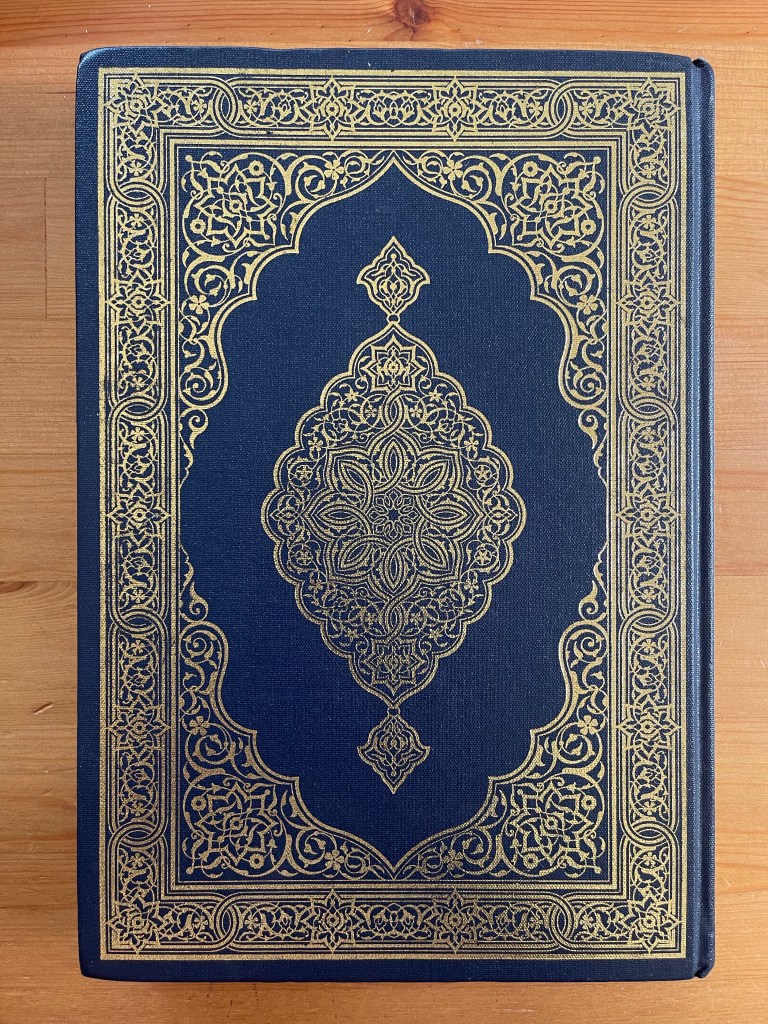
At the onset, that Quran is the one I’d place on my mahogany lectern, and it was an awesome experience. Fast forward some weeks, and I had to be on the road for a week. So, I placed this Big Quran aka BQ in an equally big brown-ish envelope, and set on the road.

Remember the picture 👆🏿of a makeshift lectern that was made of a chair being placed on a table at the balcony of a hotel in the post about mat and lectern? Yes, it was that hotel. Anyway, long story short, I forgot BQ there, I was about 5 hours drive from it when I remembered. Despite my best efforts not to forget it, the brown-ness of the envelope matched that of the table so well, that somehow, it blended with it. I don’t like squeezing it into bags so that another bag won’t be mistakenly placed on it, so I make sure it has its own space in the car. I had noticed its matchy-ness in the nights I have had to recite it at the hotel, it would take me a minute to spot it in the somewhat-darkness since I didn’t want to wake the kids by switching on the light, and I had made a mental note to self that I’d get a green pouch for it as soon as we returned home.
After everything was packed in the car, I’d gone to the room, checked everywhere to make sure nothing wasn’t forgotten, sat for a while afterwards, right in front of the table it was too 🤦🏿♂️ and searched the room in my mind too. But when Allah wills for a thing to happen, nothing can stop it from happening. May Allah cause us never to forget when forgetting won’t benefit us. Amin. And may Allah cause us to remember when reminder will benefit us. Amin. 🤲🏿
The awesome thing that came from it was the fact that it was due to forgetting it that I started seeking alternatives; to the Big Quran, to the Lectern, and all of the alternatives I’ll be sharing with you here, and some that I have already shared with you with these series on how I made my taHajjud easy. 👍🏿
So, I phoned the hotel right away, and after 3 weeks of back and forth, with unrefunded monies spent, I got Big Quran back. But by that time, things had changed.
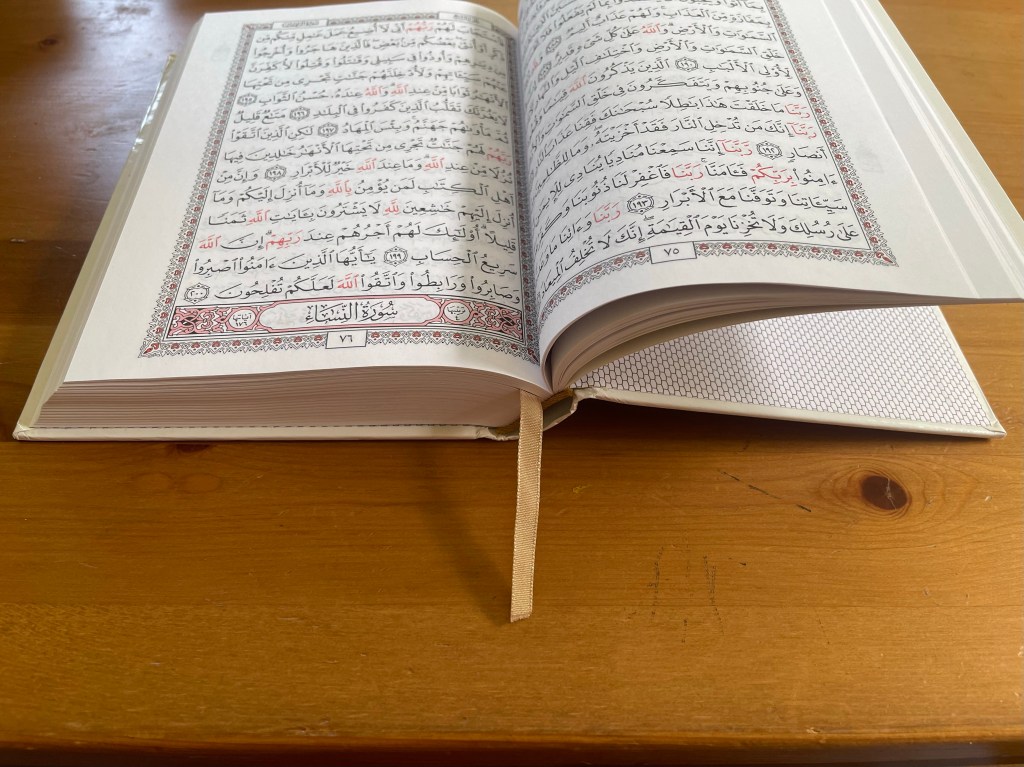
First thing was that, while I was waiting for BQ to be returned, I used Small Quran in the mean time. SQ was 8 inches by 5 inches, and the words inside was within a 6 inches by 4 inches space, unlike in the BQ that the words were within a 9 inches by 5 inches. Other than the small fonts in SQ, another reality was that its pages won’t stay opened, they keep trying to close, and so I had to place something on the pages while I recite. And I had to keep doing that all night long as I turned the pages. So, to say the least, it wasn’t conducive.
And so one day, it dawned on me that I could download the Quran on my iPad. Like! What! 🤯

I won’t have to station my lectern beneath the room’s light? 🥰 I won’t have to place something on the pages to hold them down from closing? I won’t have to be pressing hard on pages in an effort to make sure I’m not turning more than a page? I was so sold. I searched for the app of BQ, downloaded it, and even though I didn’t get the 9 by 5 inches of recitation space, its 7 by 4 was nonetheless an admirable experience.
I just have to place the charged iPad on my lectern, and that was it. It beams its own light, so I can switch off the lights in the room if I wanted to. Don’t do that by the way, that and switching on the fan, the taHajjud will be a tough one, cue in ‘sleep’. 🤦🏿♂️🙄
Another question that my new found use of the iPad answered is the question of how to transport my 15 pounds clunky lectern whenever I have to be on the road; and the answer is simple, do not transport it, instead, buy an iPad stand that I can basically sling on my back and take anywhere I go.
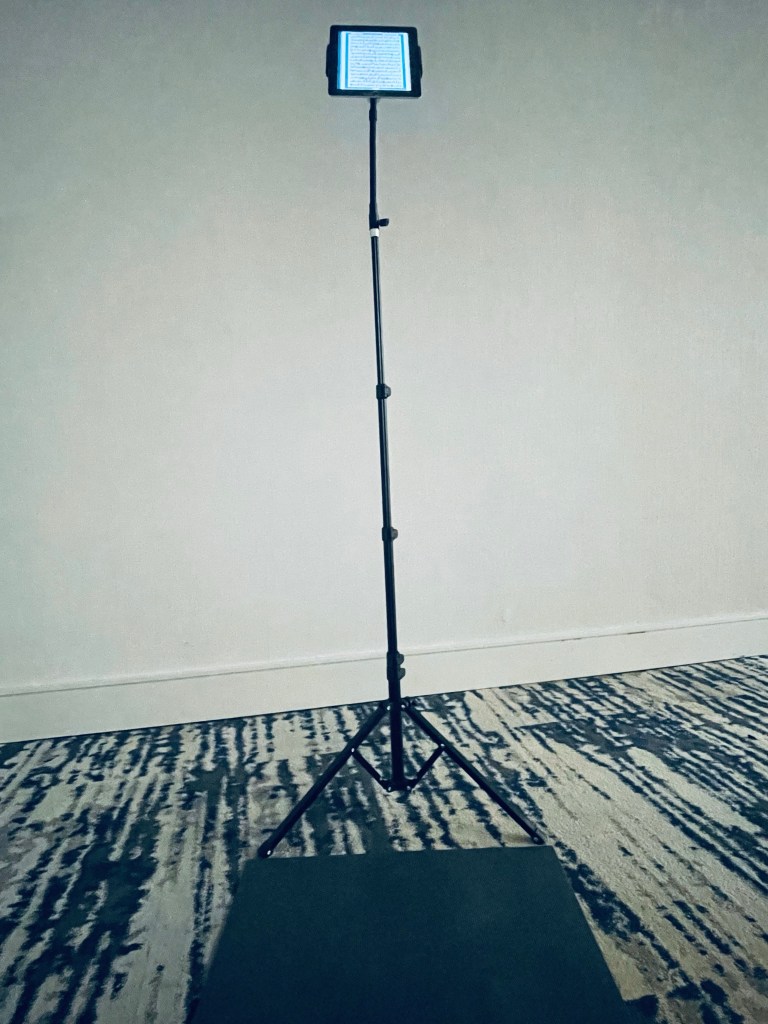
But I have provided all the options here, so that depending on one’s socio-economic situation, one is able to make the best decision that suits one.
As for recitation of the Quran, I have found that inhaling with my nose helps with making sure my recitation isn’t too fast, and that I don’t yawn. As for the latter, it’s just something I stumbled upon, I have noticed that I am more likely to yawn whenever I inhale with my mouth than when I inhale with my nose. Having written that, I should also mention that whenever it is 60 degrees Fahrenheit or below wherever you are doing your taHajjud, do not inhale with your nose, you may get sick. True story. That’s something I have noticed from doing taHajjud in outdoorsy spaces over the months. First night may not get you, but by the end of the third night, you may start to sniffle, mild headaches starts creeping in, fever, and then you are full on sick. So, be mindful of when you’ll nose-breathe, and when you’ll mouth-breathe. And yes, you can mouth-breathe, or switch between nose and mouth on such cold nights. 👍🏿 May Allah ease your affairs. Amin. 🤲🏿
Talking of nose-breathing, another added advantage to breathing with one’s nose is that one takes deep breath every time, which basically comes with the added benefit all ‘breath exercising’ gurus swear by. Sometimes, not always, I inhale for the time it takes me to mentally say ‘SubhanaLlah AlhamdulliLlah wa laillaha illallah wallaHu akbar, wa la Hawla wa la quwata illa billahil aliyul a’zeem’, which can last between 5 to 6 seconds, and depending on the verses on the page, I’m able to take meaningful amount of breaths to finish it, instead of chopped breaths that only allows me to get 2 or 3 words out before I’m in need of inhaling again. Anyway, something to look into, pacing one’s recitation and one’s breath. 🙏🏿
I recite 20 pages every night, and when I started, I went through a plethora of ways to divide 20 into 2 parts since I finish it in 2 rakahs. And the one I have stuck to after a lot of trials is 11 pages on the first rakah, and 9 pages on the second rakah, and I tell you, it has been bliss ever since. I don’t have to be doing calculations whilst reciting, on exactly where to stop this time; had I been working with 21 pages for instance, and trying to recite 12 pages in the first rakah. That already got me dizzy. Hehe! 🤪 Anyway, my point is that 20 pages divided into 11 and 9 has made the experience easy and awesome. 🌟
As for my Witri after the shafi’ of 2 rakahs, I recite Q33 Vs 41 to 43 and Suratul Ahad. With the former, after the long and arduous night, no complaints, I find that the words in the verses to be physically and spiritually uplifting and encouraging, and the words are:
O you who have believed, remember Allah with much remembrance (41) And exalt Him morning and afternoon. (42) It is He who confers yusolli (blessing) upon you, and His angels [ask Him to do so] that He may bring you out from darknesses into the light. And ever is He, to the believers, Merciful. (43)
I know, there are lots of benefits from those 3 verses, but just the fact that Allah sends Solawat on anyone that does Dhikr, and of course the ultimate Dhikr is Allah’s words, and so does the angels… 🥰🥰🥰 Count. Me. In! on those striving to even be in the ambiance of that.
As for the benefits of taHajjud, in the little I want to share of the benefits of taHajjud other than the hundreds of ahadith you’ve read on the issue is the story of the Scholar and his Student.
The summary of it is that the student asked why he should continue reciting the Quran even though he is unable to grasp its full meaning. To which the scholar took him to a well, emptied a bag of coal, and gave it to him to use to fetch water from the well. The student did as was asked and when the Scholar returned, the student basically told him that he was unable to fetch water from the well with the cloth bag despite his hour long attempt. To which the scholar highlighted the fact that despite the fact that the cloth bag wasn’t able to retain the water, the bag is now clean, from the student’s continuous attempt at fetching water by immersing it into the well.
And he likened that to the spiritual Self; that despite perhaps one being unable to fully grasp the meaning of each word of Allah, some words or the entire Quran even, by one continuously immersing one’s self into it, one’s soul continues to be purified.
And the reality is that eventually, one will start retaining bits and pieces of the Quran. And the main intention of this website is to share bits and pieces of the Quran, and how they can be understood in light of the Classical Arabic meaning of the words, since that was the form of Arabic that was spoken when the Quran was revealed. It’s best to try to have that understanding. That way, mere recitation of the Quran will move one just as it moved the polytheists of Makkah, so much so that they’d tell their compatriots to plug their ears from listening to the Quran. It didn’t avail them, they listened to it nonetheless, and accepted it to be true, and that it can only be the words of the Lord of the worlds. Them, without any tafseer class, or prior islamic education, would just listen to the Quran, and it moved them enough to abandon their entire life before listening to the Quran to dedicating what’s left of their lives defending it, with their lives even. And they were able to do that because they understood each word on a deeper level, a literary acumen that has since been lost, and that this website seeks to remedy one post at a time. InshaAllah. 🤲🏿
What has happened today is that via Modern Arabic, translations, despite their good intentions, have watered down the meaning of a lot of the words in the Quran. And the average muslim isn’t thinking deeply about the Arabic words. As with English, understanding the essence of the word takes one to Greek, Latin, French, German and the likes; as for Arabic words, the search should take us to the Bedouin – the etymology, how the things they interact with everyday shaped their understanding of reality and their expressions of words, meaning, emotions et al.
All of these may seem abstract, but I can give you a glimpse of what I’m talking about in the word ‘Quran’ itself. You see, when you say ‘Quran’, nothing really comes to mind other than a bound book that has all of 114 chapters of Allah’s words, right?
So, first things first, the word ‘Quran’ and ‘Iqra’ are from the same root alphabets, qaf, ra and alif. You know, Iqra, the same first word that was revealed to the Prophet pbuh in Q96 V1. And so by that there’s the idea of to read, to recite, to proclaim, and by extension the Quran means a book meant to be continuously read, recited and proclaimed. Qara (Iqra), 6 forms of the word was used in the Quran; qara 14 times, quri’a twice, yuqri 1 time, al Quran 50 times, Quran 20 times, and quru 1 time; making a total of 88 times.
Secondly, the narration goes that Jibril was saying to the Prophet pbuh, ‘Iqra’ (read), and he replied with ‘I can’t read’, and Jibril would squeeze him tightly in his embrace, the latter tighter than the former, so much so that the Prophet pbuh thought that he’d die from the tightness of the embrace. And the prophet would reply with ‘I can’t read’, and that moreover there was nothing to read.
However, now that we know that Iqra also means to recite, some scholars are of the opinion that Jibril meant Iqra to mean ‘recite’, and not that he should ‘read’ from a book. That he should have repeated after him. Which is what he would eventually start doing subsequently. It would basically be installed in his mind, instantaneously, and he would have to recite it to the people. So, there’s that meaning of Iqra. 👍🏿
Thirdly, classically, the idea of reading and reciting is born out of the primary idea of ‘putting things together’. In this case, the alphabets. Words are made by putting alphabets together to make words or texts. Talking of ‘text’, it’s from the Latin root word ‘Texere’ which also means to ‘weave’, weave threads together to make a cloth, a TEXTile, get it? 😁 So, even in English, the word for ‘text’ also has the etymology of ‘bringing things together’ to make something, in this case, alphabets for words. And as we will see, even in the Quran it was used for other than bringing ‘words’ together too.
And so, it is said that the Quran is also called the Quran not just because it is filled with ‘bringing together’, qara or texts, but because it brings together, bounds together the words of Allah in its 114 surahs.
Classically, ‘aqraatin naqah’ is said of the sperm of the camel lodged in the female camel’s womb and gathered there or stayed there: qara’atin naaqah means the she-camel became pregnant. For blood to clot in the womb also is said to be qar-un. Aqra’atil mir’ah is said when a woman has qau-un or menstruation. The plural of qar-un is quru-un, as seen in Q2 V228 wherein Allah said ‘thalata quruu-in’, translated to ‘three periods’, three menstrual cycle and the likes. Wherein it says “Divorced women remain in waiting for ‘three periods’, and it is not lawful for them to conceal what Allah has created in their wombs if they believe in Allah and the Last Day…”.
So, with the Scholar and Student story above, we see how the continuous recitation of Quran can purify one; well, it turns out that the bringing together of blood, endometrial tissue, cervical mucus, vagina secretion and unused ovary every month is an image Allah wants us to have in mind when thinking about the word ‘Quran’.
That, just as Allah cleanses the woman’s womb every month by ‘bringing together’ blood, endometrial tissue, cervical mucus, vagina secretion, unused ovary, and flushing them out of the woman’s system; the Quran, perhaps, with one full recitation every month, will cleanse one’s heart, body, soul, spirit and mind of all that may be ailing it. 😳 And what better way to recite it than standing in the night (taHajjud), alone, with your Lord, undisturbed and undistracted. Bliss, just pure bliss, I tell you. 🥰
You see, with Periods, the things that are being ejected from the body aren’t just ejected calmly, sometimes, in an effort to do a deep cleansing, the uterus or womb squeezes up, contracts, cramps up, brings itself together forcefully, to make sure that all that it needs out is squeezed out. In fact, it’s the same mechanism that happens during labor at childbirth. Prostaglandin is the hormone that the linings of the uterus produces to trigger, enhance and sustain contractions; same hormone helps the cervix to dilate, and it triggers and sustains contractions during childbirth labor. And the doctor may administer the Contraction Hormone for whatever reason, whether it be in a situation where it is required, as in when the woman is induced due to stillbirth or for any other reasons the doctor deems necessary.
So that technically, every woman is ‘birthing’ albeit on a much lower scale every month. 🤯🤯 Perhaps, part of the wisdom of that is also to get the body used to the pain slowly, that way, the big one won’t be such a shock to the system. 🤷🏿♂️
So, we see that this cycle didn’t just get rid of unwanted stuff from the body; it, by doing that, squeezing, contracting, gave life a chance, another life, a new life, a new cycle begins. 👍🏿
I couldn’t help but notice that in Q96 where Iqra was mentioned, the word we are translating, what came after it is, ‘in the name of your Lord who created, Created man from a clinging substance’. Is it a coincidence that Creation was discussed right after Iqra, a word we now know has a lot to do with menstruation, birthing and the likes? Allahu Akbar! 🙌🏿
Allah admonishes us in several verses in the Quran to think deeply about the words in the Quran as seen in Q38 V29 and Q47 V24. And these are the results of deep thoughts, which every one is capable of undergoing. That’s Dhikr too. Oh, did you also notice that while Jibril was saying Iqra, he’d ‘squeeze’ the Prophet pbuh so hard? See where I’m going with this? So, perhaps, another layer of meaning to Iqra there wasn’t just that the Prophet pbuh should read or recite after him; or to memorize what’s being said or to proclaim it; but that Jibril also meant to also use the word which as we’ve seen means ‘cleansing’, to further cleanse the Prophet pbuh, getting his heart, body and soul ready for the spiritual journey ahead. To purge it of whatever needs to be purged, and renew it, to start a new cycle of life, being, and living…
In a way, men can think of reciting an entire Quran every month through taHajjud as our own Period, monthly cycle, our own ‘menstruation’ if you like, albeit a spiritual one. Just as the Womb squeezes out what it squeezes out monthly to cleanse the womb, Jibril was squeezing the Prophet pbuh to cleanse him of whatever needs to be cleansed to get him ready for revelation, get it? And now, our task is also to let the Quran, through recitation, squeeze us from within, and cleanse us in the process.
And the fatigue, tiredness, and drowsiness we experience trying to get it done, despite not being comparable to the cramp pains women feel every cycle, shows how much ‘qara’, ‘bringing together-ness’, ‘squeezing together’, that’s going on within, spiritually.
Now, if one hears the line, ‘let the Quran in, let it cleanse you’, one doesn’t just have an abstract idea of the word ‘Quran’, one is thinking up a lot of possibilities of the word, some of which I have highlighted in this piece, and others that will come to you as you think deeply about the word.
When the story of the Scholar and Student by the well with the coal bag tells us the Quran cleanses one from within even if one is unable to retain its meaning, just as the well’s water does to the bag; one is able to really visualize and experience such reality in the word ‘Quran’.
So, come with me on this cleansing journey, on this journey of monthly spiritual rebirth, the journey into the words of the Creator of everything, and because nothing will exist without it being created, everything around us is a testament to the greatness, love and care of the Creator. 🥰
Come with me, and let the Quran in, let it give us its painful truths, and let it wash away the lies and doubts within us, the anxieties, the depressions, the sadness; let it remove us from darkness into light as Q33 V43 says. In fact, knowing that the Quran is Dhikr, makes us understand that verse and the two verses before it in a different light. It says:
O you who have believed, [idhkuru] remember Allah with much [dhikran] remembrance (41) And exalt Him morning and afternoon. (42) It is He who confers blessing upon you, and His angels [ask Him to do so] that He may bring you out from darknesses into the light. And ever is He, to the believers, Merciful. (43)
And so, here, we see one of the benefits of the recitation of the Quran is that it brings one from darkness to light. Despite our inability to see the light that we are in, spiritually, the transition is happening.
The image of darkness, of being in darkness, in a dark place, brings with it fear, fear of the unknowns; pain, pain, from stubbing one’s toe, hitting one’s head again and again at objects mobile or immobile, obstacles in life.
The image of being in the dark brings anxiety to fore, because since one isn’t certain of what’s in the dark, perhaps, a cliff, everything and anything will trigger one. Restlessness, depression, fear induced inertia and the likes.
But as soon as the light comes on, as soon as we let the light come into our soul, by constant recitation of the Quran, not just during taHajjud; while walking down the street, waiting for something, 5 daily prayers is also an avenue where we recite the Quran, when we let the light of the Quran in, there’s clarity, clarity of thought, and of being. There is peace, peace of mind, of thought, of being, of knowing. There is purpose, and excitement to reach every day for it.
Unlike with being in darkness, one is bereft of purpose, because one can’t seem to see even one’s self talk less of seeing something to achieve. But with light, there’s purpose, there’s life; there’s healing, healing of the heart, mind and soul, all of these and more, when we recite the Quran. Allah said in Q41 V44, ‘…It is, for those who believe, a guidance and cure…”, and in Q17 V82, Allah said, ‘And We send down of the Qur’an that which is healing and mercy for the believers…’ So, let it in, use taHajjud to let it in, and day after day, InshaAllah, we are cleansed, purified, and at ease and bliss. Amin. 🤲🏿
On this website, my goal is to share understandings of some of the words of the Quran, which you can type in the search box. And if you still don’t have a full grasp of the words, you can always use the Classical Arabic dictionaries I have shared on this website too, and if that still doesn’t help, and or you just want me to write on the matter, you can always email us your questions at emails@themarhaminstitute.com, and InshaAllah, we’ll understand the expressions together.

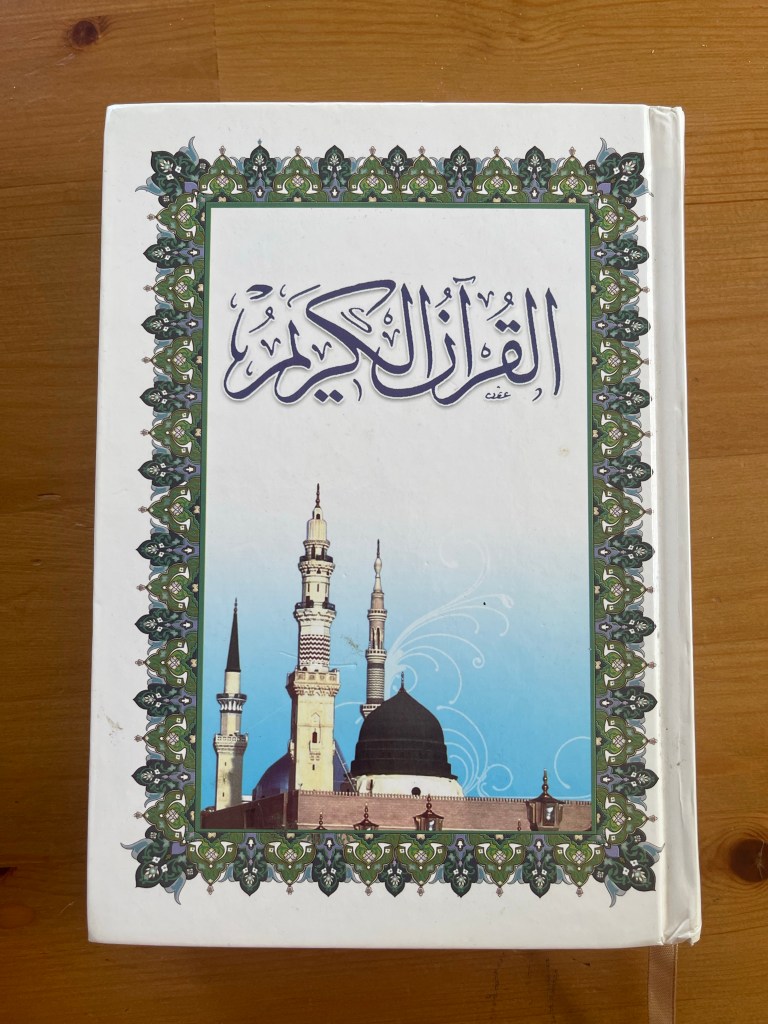
Back to the mus’haf issue, Quran 1 above is the mus’haf I use for my taHajjud now. It doesn’t have English translation in it, and it is numbered as the physical Quran pages are numbered so I’m able to keep track of my recitations. Quran 3 has English translation, and it is numbered, but I prefer to use Quran 1 because the fonts are bigger, or so it seems. As for Quran 2, every muslim should have it on their phones or any other mobile devices they have. Though it is not numbered by the pages, its English translation goes a step further by breaking the verses down by the words. So, if you are a non-Arabic speaker (or even if you are one), you can know exactly what word you want to look up.
On this website, I have provided 4 Classical Arabic Dictionaries, and here, I will give you an idea on how to use them:
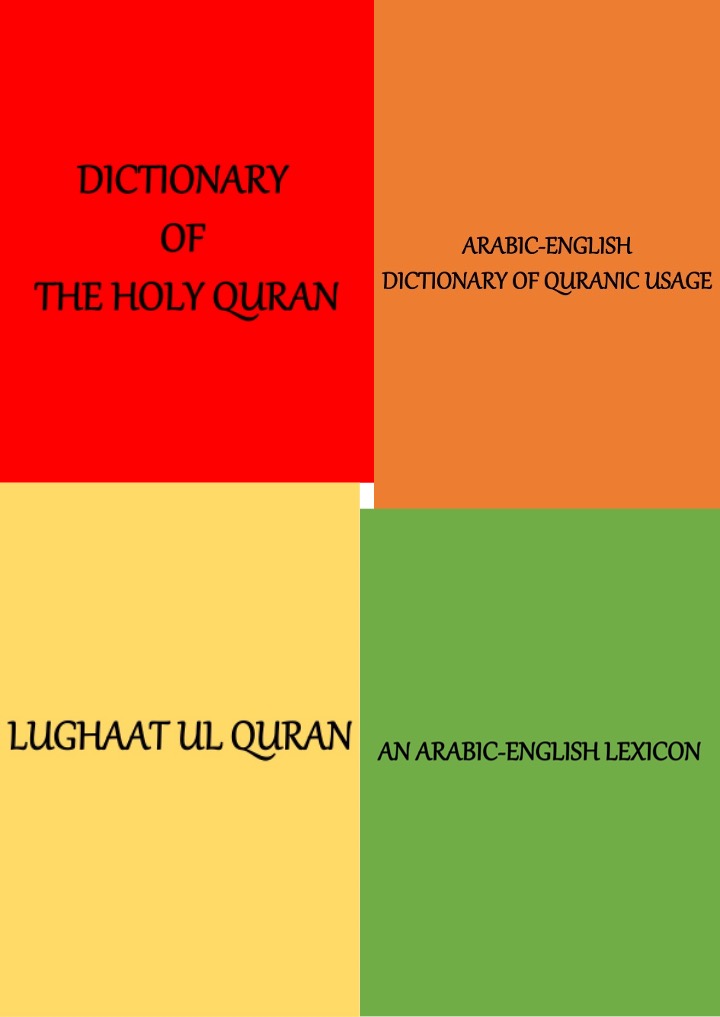
When you get the word you want to look up using Quran 2, say for instance, Iqra, the Red Dictionary above is the first dictionary you should head to. And there, you will find ‘Iqra’, and what you will also find is the root alphabets of the word Iqra, which are qaf, ra and alif. The other dictionaries assume you already know the root alphabets of the word you want to look up. You can then flip to the page in the Red Dictionary and read the meanings they have there. Quite brief if you ask me, and that’s where the Orange Dictionary comes in, it goes a step further, and you will be exposed to more details. With the Yellow Dictionary, you will be getting the root meaning of the word, where and how the meanings were derived and deduced. It may confuse the untrained mind, but it is where certainty of meaning comes from. As for the Green Dictionary, if whatever you find in Yellow isn’t clicking, Green will show you more ways to help you make sense of it. InshaAllah.
But you can’t just go to Green, Yellow, or Orange without starting from Red, and you won’t be able to go to Red without first knowing which word you want to look up – cue in Quran 2. If after you’ve done all of these, you still want our 2 cents on the matter, you can always email us. Thanks, and have an awesome night. May Allah make it easy, and ease our affairs. Amin. 🤲🏿
 themarhaminstitute
2 thoughts on “how i made my two-hour tahajjud easy: the Quran, period. Pt. 5”