To start with, my intention was to title this piece ‘uv rays, viruses, vicissitudes, virtues and privacies: a classical arabic exegesis of the verses on the veil’, but I thought that would be a mouthful, and frankly, too academic, despite how academic this piece is. Hehe! Hopefully, you enjoy reading it more than I did writing it. 😁
So, we’ll start with the Q33 V59, wherein Allah says:
“O Nnabiyy (Prophet), tell your Azwajik (wives) and your Banatik (daughters) and the Nisai (women) of the Mumin (believers) to Yudneen (bring down) over A’leyHinna (themselves) Min JalabeebiHinna ([part] of their outer garments). That is Adnaa (more suitable) that they will be Yu’rafna (known) and not be Yudhayna (abused). And ever is Allah Forgiving and Merciful.”
The first insight one can draw from Q33 V59 above is the question of why Allah added the ‘Prophet’ and the ‘male believers’ to the mix; Gẹ could have spoken to the women directly as in Q33 V35, but by calling on the prophet to tell his wives, daughters and women of the believers to cover up; Gẹ is putting the prophet and the male believers on alert, so that they know that if after they’ve covered up, or if they don’t; if anyone tries to cause them harm still, they must be at the fore front of defending these categories of women.
And here, part of the women added to the category that it applies to are ‘women of the believers’, not ‘muslim women of the believers’; thereby making the categories of the women that the men must defend open, welcoming and endless. And by particularly adding the prophet to the mix, Gẹ is making sure that muslim men in whatever era know that by defending women’s rights, they are upholding Allah’s words, and following in the footsteps of the prophet pbuh.
It is important to start this piece with that theme in mind, because as we will see, part of the spirit in which Q33 V59 was revealed, was so as to be able to defend women from attacks; and one can argue that men are included in those that should be defended too.
It is also important to note that V59 is a continuation of V58, it cannot be read in isolation. V58 starts with, ‘those who yudhuwna (harm) believing men and believing women…’, and V59 after mentioning what should be done, ends with ‘… so they will be recognized and not yudhayna (harassed)…’. So, as we can see, these verses are about some of the things that can be done that will bring one close to not being harmed or harassed.
Let’s start with the name choice Allah decided to call the prophet pbuh with; Nnabiyy. Its root alphabets are nun, ba and alif, and 10 forms of it occurred 160 times in the Quran. And it means news, to give someone news as seen in Q49 V4, Q15 V49, Q26 V69 and the likes. And from it comes the idea of prophecy, to predict, to foretell, to prophesy and the likes. The idea that also flows from giving news is the fact that someone that wants to give a piece of information finds a high place to stand on so that the information can be heard by all, a podium, stage, hill top etc, and so he mounts a high place; and so Nnabiyy also means to be elevated, to rise, to overpower and the likes.
When the prophet pbuh was going to announce his prophethood to the Quraish, he ascended on a high place, and asked the people if they would believe him if he told them that an army was marching towards them right now from the other side of the hill, and they said they would; and that was because he is known to be trustworthy, and also because he has a vantage point of seeing what’s on the other side.
So if one is being given news on how to defend one’s self, it would be best if it were coming from someone whose position is high enough that his vantage point will be accurate; thus, a Nnabiyy. So, right out of the bat, we are made aware of the fact that the information that is about to be given is one from one that has the best spot to give a perfect defense tactics. It will be best to listen to his words, and to not listen to his words – as with all wars that its soldiers desert, or do not listen to their commander’s orders – the result harms not just the soldiers, but the entirety of the people they had intended to defend, their civilization, their traditions, and their well-beings.
So, Allah tells the Nnabiyy to tell his wives, his daughters and the women of the believers to ‘yudneena a’leyHina min jalabeebiHinna’. Yudneena’s root alphabets are dal, nun and wa. 6 forms of the word has been used a total of 133 times in the Quran, and in fact, 2 of those forms were used in this verse.
Dana means for something to be near, to come close, to approach, to bring close; to approximate; this life (as opposed to the next); the world, the earth; to become bare, to behave despicably, a vile person. Of this root, six forms occur 133 times in the Qur’an: dana once; yudni once; dani once; daniyatun three times: adna 12 times; al-dunya 115 times.
So, classically, how did dana come to mean all of these things? Let’s start with this, you see, dana is said of the fruit that is low, and because it is low, it is near one. Q55 V54 is an example of the ‘low and near’ definition of dana. There, Allah talks about the fruits in paradise, that they will be dani, hanging low and close to one, no need to be throwing stones at them, or trying to pluck them with long sticks. Dani is also said of some fruits here on earth as seen in Q6 V99.
Q53 V8 buttress this point even further where it states that Jubril ‘thumma dana fatadala’, which then means that Jubril came down and was close to the prophet pbuh, and fatadala means that Jubril hovered in this state of close proximity to the prophet pbuh. So, with dana, we aren’t just looking at something coming down, it’s a ‘coming’ that must also come ‘close’ or ‘near’ one.
One more example of that before we move on.
Q30 V3 states about the defeat that the Romans will suffer to be one that they’d be ‘fi adnal ard’, which has been translated to ‘in the nearest land’, or some say ‘nearby land’ taking into its close ‘Proximity’ to Persia, but the miracle of Allah through the Quran was confirmed over a thousand years after, as if the miracle that that same verse produced back wasn’t enough, over a thousand years later, it has now been confirmed that the same spot just happens to be the place with the lowest altitude on earth. 🤯
So that we now know that dana means for something to be low and close, and it is from this idea that this life, or our existence has come to be called duniya, as opposed to the akhira, get it? It is here, and it is low, unlike the akhira that’s still far out, and there are talks of high levels of jannah. The earth is also said to be duniya, because it’s close to us, we stand on it, eat from it, ride on it, it is right below us. Someone behaving badly is also said to be duniya because they are behaving lowly. Someone who humbles themselves, brings themself down, doesn’t make show of themself, their beauty, state or position, can also fall in the realm of dana.
It is important that this definition is looked deeply into especially because as we will see, two forms of the world was used in this verse, and another word, yadrib, which is popularly translated to mean ‘bring down’ was also used twice in one of the verses on the veil that we will be looking into. InshaAllah, we will refer back to this definitions when we get to them.
So, Allah is saying here, that these categories of women should bring low and close ‘aleyHina’ upon themselves their ‘jalabeebiHinna’. So, what is Jalab? The root alphabets of the word are jim, lam and ba. And this word occurred once in the Quran; and another word which is also a variant of it occurred once too.
Jalab means that he drove, brought, conveyed a thing like a horse, sheep, or camels, goats or any of such animals from one place to another. And because in doing this, one has to chid, rally, urge the animals in the process, jalab is also said to mean that, as in Q17 V64 which says, ‘And entice whomever of them you can with your voice, and ajlib (rally) against them your cavalry and your infantry…’, and so from this comes the idea of shepherding, working, strategizing, assaulting, attacking, fighting and the likes.
And because Jalab is said of the cloth one wears when one is herding animals from place to place, that labor intensive journey that may need one to scare off wolves or any other wild animals that may try to attack one’s flock, the shepherd needs his knees free, and his sleeves short, and a top to bottom slit in the cloth so as to give way for the legs to stretch as far as it can go, and of course, a rope around the waist to hold the cloth together when one isn’t running.
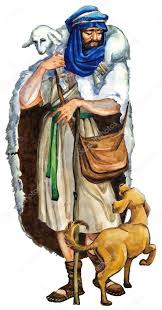

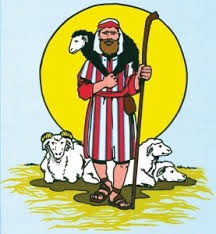
Above are pictures of what shepherds wore in classical times, be it women or men. And because that was predominantly the work done by a huge part of the community; from it they get food to eat, and milk to drink; from it they get leather to make tents to live in, shoes that they wear, mats to lay on, and fur to make cloths and the likes; and because of all of that and more, the cloth one wore to work generally came to be known as Jalab.
To make sense of this really, one has to think of a woman in this slitted short dress running around the fields, or going to work and the likes. It is this cloth, this jalab, that’s still very much being worn today with or without the slit in the Arabian or muslim dominated countries that’s being said to be brought ‘low and near’.
Low, because, it is around the knees, so it should be brought low to the feet, and near or close to one because when the slits open, the cloth moves far from one, and when one puts all these together one has what is now referred to as Jalabiya today. Some scholars are of the opinion that the jalab is the head covering, and so this is the verse about Niqab because if one brought the headscarf down, it would cover the face and all, but I think that honor should be reserved for Q24 V31 which we will get to later, InshaAllah.
But if I may say a little of it here, now, we find that Allah used Khumur in Q24 V31, Khamr is gotten from the same word, which is translated as intoxicants. And the headscarf is referred to as Khumur, while alcohol is referred to as Khamr, and what they both have in common is that they cover the head, the former physically, while the later metaphysically, or biologically. When one is drunk, their mind is veiled, so you see the connection? A-ha! 👍🏿
Another reason why I believe jalab cannot be the headscarf (niqab) is because Q24 V31 calls out specifically to the muminat, it doesn’t include ‘women of the mumin’ who may or may not be Muslims.
Allah, here, is basically instructing us on how to go about workplace fashion that not just muslim women should imbibe, but ‘women of the believers’ should too and Allah went further to give its benefits, which we will get to in a bit.
As we’ve seen, the classical jalab is basically a short dress with some massive slit on it. And now, Allah is stating that it should be long, and unslitted. And this take us to the benefits of wearing this long dress that has no slits on it.
Q33 V59 states that this is more ‘adnaa’, a form of ‘dana’ that we discussed extensively above. So, now, let’s insert our ‘low and nearer’ formula into this sentence. Low here means to humble one’s self, don’t forget this verse is about cloths for women; the first benefit we derive from wearing the jalab the proper way other than of course, obeying Allah is that it’s a means of humbling one’s self in the land. And what does it bring one closer or nearer to? As the verse says, to being known, recognized (yu’rafna), and not harassed or harmed (yudhayna).
The root alphabets of yu’rafna are ain, ra and faf, and 10 forms of the word was used 70 times. Part of its meaning is to recognize, to know, as in Q49 V13 which says ‘O people! We created you from a male and a female, and made you races and tribes, that you may know (a’rafu) one another…’, because if all seven billion plus of us were of the same exact color, height, gender, the same look and the likes, it will be a great hassle for us to be able to ‘recognize’ or ‘know’ one another, wouldn’t you agree?
I think there are levels to the recognition benefit in this verse, and the first of which is that they are recognized as either being muslim women, or being women of those that submit to the most High. And this recognition can be done by both men or women alike. The second recognition is that from just men. I mean, if one were to think back, it’s easy for one to see that men were definitely if not outrightly physically harassing them, but checking them out and the likes. So these men will recognize them as muslim women and not ultimately harass them, this is especially true because this was a time that in-house restrooms weren’t a thing, women had to go pee and poo as far away in the desert as possible to the prying eyes of the men. A time that they’d go round the Kaaba naked as an act of worship, a time where infant girls were buried alive just because they were female, a time where women could prostitute themselves to men and decide later who to give the pregnancy to, in a nutshell, morals were loose.
I think the third recognition has to do with the benefit of covering one’s skin generally from the elements. Ultraviolet rays from the sun and from other artificial sources can cause sunburn. The ultraviolet rays, by touching the cloths and not the body, is taking cognizance of not one’s skin, but of one’s cloths, it’s not yu’rafna-ing one’s skin, but one’s cloths. And by so doing, one is prevented from premature aging of the skin and other signs of sun damage such as wrinkles, leathery skin, liver spots, actinic keratosis, solar elastosis and the likes. The less skin one shows, the lesser the damage the ultraviolet rays will do to one’s skin.
Now, let’s go into the other benefit one derives from wearing one’s jalabiya the way Allah wants us to wear it, which is yudhayna, harmed, harassed and the likes. We’ve already looked at some of the harm that can come from not covering one’s skin both from men and the sun.
The root alphabets of yudhayna are alif, dhal and ya, and 3 forms of the word occurred a total of 24 times in the Quran. And it is said to mean to harm, to injure, to damage, to persecute, as in Q6 V34 that says ‘Other messengers before you were rejected, but they endured rejection and udhu (persecution) until Our help came to them…’. Q2 V263 and parts of V264 states that “Kind speech and forgiveness are better than charity followed by adha (injury)… O you who have believed, do not invalidate your charities with reminders or injury (adha)…”
From these three verses, we see that the ‘harm’ can be physically violent, verbal or of any other harmful nature that can invalidate one’s charities. So, when they are fully clad in their newly fashioned work cloths, they are “dana ‘closer’” to men not harassing them with their eyes, mouth or their hands. They are left alone to walk humbly by, except of course, from the troublemakers.
And just as it means physical injury, harm or visible harassment, it also means an unseen harm, like infections and the likes, as in Q2 V196 that says ‘…so if any of you is mmariddan (ill), or has an adhan (ailment) of the scalp…’.
It is important to note that in the verse above Allah made sure to differentiate between marid and adhan, and the implication of it is that while adha is an infection, it can become marid if left untreated, and then one becomes ill. That’s one of the benefits of wearing a dress that covers all of one’s body, the jalab, the fact that a mere cloth can prevent infections is just phenomenal, especially now that we are living through a pandemic that’s viral in nature.
Now, we are told to put on masks, most of which are made from fabric, so that somehow if the virus comes to one’s face area one doesn’t ingest it through one of one’s face openings. What then happens to the ones that don’t make it to the face? Whether viral, bacteria, fungi (oh, those fungi) and the likes? They stick on one’s cloths for as long as they can, and that’s why even now, we are advised to take off our cloths as soon as we get into the house, and if able to, take a bath, before changing to house cloths. Talking of ‘house cloths’, the Quran mentioned it in Q24 V58 and V60 as Thiyab, but we’ll get there in a bit. InshaAllah.
Anyway, see where I’m going with this? Adha also means infections, and part of the benefits of wearing the jalabeeb as mentioned in Q33 V59 is so that it is likely to guard one against infections. Allahu Akbar! Having been studying the Quran for a while now, what I have found is that whenever Allah refers to the Prophet as Nnabiyy, and tells him to say something, Allah is about give us something only a Specialist should know, a Specialist in the next one thousand years nonetheless.
Let me digress a little bit.
If you consider the Classical Arabic definition of Nnabiyy that we looked into at the beginning of this piece, one of the words that summarizes the idea other than Prophet (prophecy), is ‘Specialist’. It’s only a Specialist’s vantage point on a matter that really matters, right? And here, Allah uses Nnabiyy, and it comes full circle, right? We see how profound the usage was; Allah didn’t use Rasul, a’bd, or any other word, but Gẹ used Nnabiyy. It’s even more remarkable when you realize that Allah also refers to him as Nnabiyyal Ummiyy, the unlettered prophet, the unlettered specialist. Quite an oxymoron, wouldn’t you agree? We only believe the Expert because of their knowledge of the subject matter, but Allah, here, is letting us know that the revelation is true. He is unlettered, there’s no way he’d know something that if implemented, would have saved millions of lives over the centuries. Communicable diseases, airborne diseases, et al, and yet, here, he is relating them to us, easily, without the technicalities or expenses of scientific methodologies.
This Nnabiyy told us to wear the jalabeeb, to wash our hands, mouth, nose, and most of our body at least five times a day, to change our cloths when we get home, to be clean always, he was basically the World Health Organization of his time, and of all times. Anyway, you get the point, let’s move on.
So, now, now that one has seen the benefits of wearing a cloth that goes low and close, and not opening and revealing what’s in, one might ask, does this protective attire, in whatever form they appear only apply to women? And I will reply with this, that V58 starts with ‘those who yudhuwna (harm) believing men and believing women…’, and that V59 after prescribing the jalabeeb ends with ‘… so they will be recognized and not yudhayna (harmed)…’. The fact that the word was used again hints at the fact that anyone that doesn’t want to be ‘harmed’, and we now know the variations of such harm – the seen and the unseen – needs to don the jalabeeb. And fortunately, as we see today, men and women wear the jalabeeb, popularly called the jalabiya.
As I have written above, that I don’t think this verse was the one about the headscarf, I think this was just about the ‘dress’, and now that we are on the subject of long dresses that covers the skin; I should mention that I use ‘dress’ loosely here. I think the purport of the verse was that the skin is covered, so if one expresses jalab in a pant and shirt that covers all the skin but the head, hands and feet, I think it will qualify as jalab too, my thoughts, and Allah knows best. Don’t forget that I’d mentioned that this verse mentions ‘women of the believers’, who may not be Muslims, and didn’t mention muminat specifically like Q24 V31 did – there, Allah adds more to this regalia of the muminat, and those aspiring to be muminats.
And as with dresses, especially when women wear them, mere walking in them may turn out to be a sashay, albeit unintentional, and Q24 V31 talks about that. One finds quickly, that while the purport of Q33 V59 is to protect the physical health of the woman (and man 😁), and so the jalab can be said to be an armor, or battle gear; Q24 V31 is more concerned about the spiritual health of the umma, and umma here includes the non Muslims. And because this is more of a spiritual commitment, Allah starts the verse by calling on the ‘Muminat’.
As we’ve seen, Q33 V59 doesn’t address the issue of whether the dress can be transparent – ummm, did you notice what I did there? Dress? Address? 😁🤦🏿♂️ – and it even says to bring the dress closer to one; one might interpret that to be skin tight, hip contouring dresses and all. And while a non-muslim woman may wear that, and still be protected from the unseen ills out there, it may not protect them from being harrassed, so, despite being ‘close’, it shouldn’t be skintight close; close there just means that it shouldn’t have slits. With what Q24 V31 does though, it wouldn’t matter whether the woman’s jalbab is skintight or not, and it is with this in mind, that Allah addresses the Muminat and those that aspire to be Muminat by saying:
‘And tell the believing women (muminat) to reduce [some] of their vision and guard their private parts and not expose (yubdeena) their adornment (zeenat) except that which [necessarily] appears (zoHar) thereof and to wrap (yadribna) [a portion of] their headcovers (khumur) over their chests (juyuwb) and not expose (yubdeena) their adornment (zeenat) except to their husbands, their fathers, their husbands’ fathers, their sons, their husbands’ sons, their brothers, their brothers’ sons, their sisters’ sons, their women, that which their right hands possess, or those male attendants having no physical desire, or children who are not yet aware of the private aspects of women. And let them not stamp (yadribna) their feet (arjul) to make known (liyulam) what they conceal (yukhfeena) of their adornment (zeenat). And turn to Allah in repentance, all of you, O believers, that you might succeed.’
The excerpt that we need from the verse for now is this, that Allah tells the Muminat to not yubdina (expose) their zeenat (beauty) except what is zoHar (apparent) thereof, and to yadrib (draw) their khumur (coverings) over their juyuwb (breasts).
The first word we will look at is Khumur, because it puts the verse in a lot of perspective, and shows why it had to be revealed, in relation to Q33 V59 above. The root alphabets are kha, mim and ra, and 2 forms of the word occurred 7 times in the Quran. Khamr and Khumur; the former occurring 6 times and the latter occurring just this once. Khamr is said to be intoxicants, as in Q2 V219 that says ‘They ask you about intoxicants and gambling…’, and it is so called because it clouds, distorts, blocks, ‘veils’ the mind when ingested by drinking, injecting or any other way intoxicants like alcohol, cocaine and the likes are administered.
The idea of Khamr being used to refer to a cloth, right off the bat, means that the cloth must be one that veils the head, because you know, a drunk person’s head is biologically veiled while they are in their drunken state. Even they, despite their efforts, are not be able to access their ‘head’ – brain, mind – at the time they are in their drunken state. That’s why they aren’t allowed to drive, work, or do any life changing activity whilst they are drunk. And this is the idea of Khumur, from Khamr, veiling the head, headscarf, just that in this case, it is the physical veiling of the head, not the biological-intoxicant-induced veiling.
With Khumur, one cannot see through; and so, khumur, is the headscarf, since that’s what’s used to cover the hair from being viewed by the public. Women have to cover their hair for different reasons. I should also mention here the hadith reported by Bilal and recorded in Tirmidhi and Nasa’i wherein the turban of the prophet pbuh was referred to as Khimar, making it obvious that the men’s head covering was also called khimar.
Arabian women would use the Khumur to cover their hair, and drape it backwards, that was the prevalent practice, so that they are able to expose their cleavage or some or all of their chest as the situation requires. And from the wordings of the Quran, we see that it was assumed that the women were already putting on Khumur anyway, and so Allah tells them to ‘extend’ it downwards and forward. Anyway, one of the major differences between the Khumur and the Jalab is that the Khumur veils whatever it covers totally, whereas a jalabeeb ‘may’ be transparent, a Khumur must not be, it must be opaque. And that is why the verse continues by mentioning 12 categories of people one need not don one’s Khumur in the presence of, get it?
You see, Allah, despite what have been lost in translation, used different words at specific places intentionally; Allah said what Gẹ meant, and meant what Gẹ said. We can’t just call everything ‘headscarf’, and move on with our lives, no.
Let’s digress a bit.
You see, classically, Niqab means to pierce or cut something, or for something to be worn out from constant piercing, or for one to be injured, and so the covering one puts on the said cut or injury like bandaid is called a Niqab. What is being covered here is not an injury, far from it, no? And yet, Niqab is a popular term for the full covering, that includes the face.
Niqab, as a word was only used three times in the Quran, none related to an attire; its root alphabets are nun, qaf and ba, and three forms of the word was used once – naqba, naqqabu, and naqeeba.
In Q18 V97 Allah says ‘So Gog and Magog were unable to pass over it, nor were they able [to effect] in it any naqba (penetration).’ Q50 V36 states that ‘And how many a generation before them did We destroy who were greater than them in [striking] power and had naqqabu (explored) throughout the lands. Is there any place of escape?’ And lastly, Q5 V12, wherein Allah states that ‘And Allah had already taken a covenant from the Children of Israel, and We delegated from among them twelve naqeeba (leaders)…’
As for the naqeeba, they were twelve spies who were suppose to penetrate a city to gather facts about it, and report back to the group of Israelites, who were suppose to consider whether to conquer it or not. A spy was chosen from each tribe to make twelve. I mean, the spies probably had to break a part of the city’s walls to gain entrance into the city, so even though some translations have it as chieftain, leaders and all, we now know that the character of their leadership was one that meant that they had to penetrate a city, perhaps, homes too, farms, markets, government halls, war rooms, city’s food reserve, man power etc, without being found out, and then report back.
So what we see with respect to the three mentions of Niqab is that they all have this sense of penetrating, breaking through something, breaking, exploring, openings, cracking, tearing apart, spying and the likes. If Allah had mentioned it as a cloth in the Quran, it would have been as a cloth that penetrated, or pierced something, or a cloth used to cover a cut or something of that sort, or a cloth that has cuts on it; now we are moving away from how it is colloquially being used, so that, in fact, technically, all these cloths with scanty coverings can be said to be Niqab, because it has cuts every which way, you get how classical arabic works now? 😁👍🏿
In the name of technicality and fairness, I should mention the fact that it may be that it is the tearing apart or openings in the khumur for the eyes, face and hands that made them refer to it as Niqab in the first place? So that a khumur with space for the face and hands will then be called a Niqab.
But we are getting ahead of ourselves, let’s hold that thought for a minute while we journey through the next word that will help us make sense of this, yadrib.
Allah says, tell the muminat ‘…to wrap (yadribna) [a portion of] their headcovers (khumur) over their chests (juyuwb)…’, but does yadrib mean ‘wrap’?
The root alphabets of the word yadrib are dod, ro and ba, and 3 forms occurred 58 times in the Quran. It’s the word Allah uses whenever Gẹ wants to give us a parable. Q14 V24 says ‘Have you not considered how Allah doroba (presents) an example…’, and we find it being used this way in Q29 V43, Q17 V48 and a host of other verses, wherein some use expressions like ‘set forth’, ‘coin’, ‘presents’ and the likes.
But classically, doroba is said of bringing something down. Unlike dana that we looked into in Q33 V59 that we concluded means bring the jalab low and without slits (close); doroba, as we will see, at its core, means to bring something down. And Allah didn’t use dana here because slits for the eyes, face, and hands were expected, as the prophet pbuh was reported in Sunan Abī Dāwūd 4104 to have said, “‘O Asma, when a woman reaches the age of maturity, it is not proper for her to show anything but this and this,’ and the Prophet pointed to his face and hands.”
All that said, doroba is also said to mean beating, striking, to battle, and I will like for us to go deeper into the word because it appeared twice in this verse, and its meaning is consequential to understanding this verse.
Q2 V60 states that “And [recall] when Moses prayed for water for his people, so We said, ‘drib (Strike) with your a’sok (staff) the stone.’ And there gushed forth from it twelve springs, and every people knew its watering place…”
Q20 V77 provides that “And We had inspired to Moses, “Travel by night with My servants and fadrib (strike) for them a dry path through the sea; you will not fear being overtaken [by Pharaoh] nor be afraid [of drowning].”
What we see in these two examples is that to ‘strike’, the ‘instrument’ has to ‘come down’, so that in the 2 instances mentioned above, we see that Moses must have raised his staff, and brought it down on the rock and on the sea for the miracles to happen. It is these 2 tests that I have found that helps define doroba in any form it comes in. With respect to the khumur, the khumur is the instrument that’s being brought down; and with respect to the parables above, the parables are the instruments that are being brought down.
So that when Allah said in Q47 V4 “So when you meet those who disbelieve [in battle], fadorba (strike) [their] necks…’, the instrument will be any weapon one is holding, and of course, to bring it to their necks, it has to come down on the neck. I’m of the opinion that the ‘bringing down’ here may refer to ‘threat’, and not necessarily ’death’, even though death may occur in the process, because the rest of the verse suggests that they’d still be alive to be bound, ransomed or freed. The verse continues thus ‘until, when you have athkhantumuHum (inflicted slaughter) upon them, then secure their bonds, and either [confer] favor afterwards or ransom [them] until the war lays down its burdens…” Athkhantum also means to ‘subdue’ someone.
Anyway, we get the point, ‘bringing down, an instrument’. Q8 V12 is where it can be translated to see that the bringing down of an instrument may cause ‘death’, wherein Allah says, “[Remember] when your Lord inspired to the angels, ‘I am with you, so strengthen those who have believed. I will cast terror into the hearts of those who disbelieved, so fadrib (strike) [them] upon the necks and wadrib (strike) from them every fingertip.”
Now, you will agree with me that doroba itself doesn’t mean death, cut, strike, split the sea, split the rock et al, but that those are just the consequences of having done doroba, and that doroba is to bring down an instrument, which can be a staff, weapons of any kind, parable, khumur, and as we will soon see, the feet too.
Now, to where I was going with all these, since we’ve already defined doroba to mean ‘bringing down an instrument’ couple of paragraphs ago, you must have been wondering where I’m going with all of these, hehe! Sorry, it will be worth it InshaAllah. It is none other than Q4 V34 and V35, I will InshaAllah still write an entire piece on it in future, but I figured since it’s intrinsically one that’s related to a woman’s wellbeing and protection, that I’d venture into it a little bit here.
A translator translated Q4 V34 and V35 as, “…But those [wives] from whom you fear nushuza (arrogance) – [first] advise them; [then if they persist], forsake them in bed; and [finally], wadrib (strike) them. But if they obey you [once more], seek no means against them. Indeed, Allah is ever Exalted and Grand. 35. And if you fear dissension between the two, send an arbitrator from his people and an arbitrator from her people. If they both desire reconciliation, Allah will cause it between them. Indeed, Allah is ever Knowing and Acquainted [with all things].”
There, our dear ‘doroba’ was translated to mean ‘strike’, to strike, beat or slap the woman. 🤦🏿♂️ Isn’t this one of the reasons she started wearing the jalab in the first place? So that she won’t be harmed? Remember the benefit Allah stated in Q33 V59? 🤦🏿♂️ Anyway, let’s input our keywords of what doroba means into this, and see where it takes us:
“The instrument, and it being brought down”.
We see that whether it is with the Staff of Moses or the Weapons of the Believers, the person holds it, and brings it down on something, takes it down somewhere; and so the ‘instrument’ in this verse is the ‘spouse’, not the ‘hand’, if the hand was intended, it would have been mentioned just as the staff of Moses was mentioned above, but the ‘spouse’ was mentioned, and so it is the spouse, not the hand, fist, belt or whatever weapon a spouse might seek to harm their spouse with; and the said spouse is expected to be ‘brought down’ to ‘you’, as seen in V35 that says, ‘And if YOU fear dissension between the two, send an arbitrator from his people and an arbitrator from her people…’, now, who is ‘you’?
Allah could have mentioned ‘Judge’, ‘Therapist’, ‘Counsellor’, ‘Mutually Trusted Friend or Relative’, et al, but Allah decided to leave it open, so that whomever the husband or wife decides to take their spouse to to get rid of whatever nushuz either party is showing is not limited, and restrictive, and it’s able to adapt to cultures around the world, or the particular character or choice of the spouses in question, so that the parties need not expose themselves on a matter that may be settled amicably without the world being made aware.
We see with V34 that after wadrib was mentioned, Allah said ‘But if they obey you [once more], seek no means against them.’, the assumption of obedience cannot be from violence, for one, if the said spouse was 20% upset about whatever was going on in their lives, slapping the said spouse can only exacerbate the matter, not eradicate it, so that the said spouse will then be 101% enraged, no? So, violence couldn’t have been the purport of that word in that verse.
Obedience may only come from the intervention of a mutual counselor, who they trust, something private, perhaps, their therapist, it may be a judge too, in a private setting, and if that solves the problem, then, ‘seek no means against them’. But if not, Allah then turns the responsibility squarely on this counselor, and says, “And if you fear dissension between the two, send an arbitrator from his people and an arbitrator from her people.”, it is only then that the matter may go public.
To assume that V35 is not a continuation of V34, or that even V34 if read in isolation means to harm one’s wife cannot be the truth. The prophet pbuh is not recorded to have harmed any of his wives, and the idea that doroba in Q4 V34 means to strike one’s wife or spouse, with due respect, is a lack of understanding of Classical Arabic nuances, and really, submission to the linguistic expressions of the Quran. And Allah knows best. I guess here is the perfect place to insert the saying of the prophet pbuh that was reported by Abu Hurayrah that says, ‘The believers who show the most perfect Faith are those who have the best behaviour, and the best of you are those who are the best to their wives’. Perfect faith being made akin to being good to one’s wife. Enough said, especially because, as we know in Islam, the wife can also divorce her husband, so, violence is perilous to the relationship, not advantageous.
So that the progression of intervention is Advise, Abstinence, Private Consultation, and Public Arbitration, and Allah ends the verse by saying, ‘If they BOTH desire reconciliation, Allah will cause it between them. Indeed, Allah is ever Knowing and Acquainted [with all things].”
Anyway, we’ve gotten what we wanted from this exercise, which is ‘instrument’, and to ‘bring down’, as the keywords that explains doroba. In applying it to Khumur, the headscarf, it means to bring it down the body, and the part of the body that Allah mentions right away that this khumur must cover as it comes down is the ‘juyuwb (chest)’.
Juyuwb, its root alphabets are jim, ya and ba, and 2 forms of it occurred 3 times in the Quran; jayb twice, and juyuwb once. Jayb was said with respect to Musa. In Q27 V13, and Q28 V33, Moses was instructed to put his hand in his jayb, and remove it, and it will turn pure white, and that will be one of the signs that Musa was expected to go and show Pharaoh, and his people.
Classically it is said to be the neckline of a garment; to cut out, to hollow; breast, bosom; entry point et al. Basically, any hole in a garment is said to be Juyuwb, but primarily the hole that lets the head in is mainly seen as the juyuwb, because it’s the one that lets the body in. So the juyuwb includes the neck, the chest, the hole or space between the breast – the cleavage that is, and any such holes that’s around the neck that may reveal what’s within.
In essence, the chest, cleavage, and that area around the neck downwards will be regarded as juyuwb. Now, the question is, does the khumur end when it is past the chest area or does it have to continue down? I don’t know, I think it should continue as far as it continues to cover what may be considered as zeenat, which Allah stated twice in this verse should not be displayed.
Allah says, “’And tell the believing women (muminat) to… not expose (yubdeena) their adornment (zeenat) except that which [necessarily] appears (zoHar)… and not expose (yubdeena) their adornment (zeenat) except to their husbands…”
As for yubdeena, the root alphabets are ba, dal and waw, and 7 forms of it occurred 31 times in the Quran. It means for something to appear, to be apparent, to be open, to be displayed, to manifest, to be plain, to be evident, to be disclosed, to show, and because the desert has this quality of being an open space, that one can see everything; the desert is also said to be ‘baduw’, and so is the desert dwellers – in fact, ‘bedouin’, that english word, is derived from it. So that someone that lives in an open space, vast land where all can be seen is called a bedouin.
So, don’t bare your zeenat, like the desert does of itself. What then is zeenat? Its root alphabets are zain, ya and nun, and 4 forms of the word appeared 46 times in the Quran. And zeenat is said of the things one uses to adorn something; the thing one uses to decorate, beautify, ornament, embellish something, as in Q37 V6 that says of the skies that ‘We have zayyanna (adorned) the lower heaven with the zeenatin (beauty) of the stars’. Also, Q18 V7 says that ‘We made what is upon the earth an ornament (zeenat) for it…’. And Q20 V87 says ‘…but we were made to carry loads of people’s zeenat (ornament)…’
With Q20 V87, we see that zeenat can be jewelry, some beautification one adds on, while with Q18 V7, we see that zeenat can be something beautiful that grows from a thing just as flowers would be considered beautification for the earth. With Q37 V6, we see that the stars, and some translators have it as planets, are not attached to the skies, and so it need not be something attached to one’s body, while something attached to or that grows on one’s body can also be referred to as zeenat.
So, if we feel that the jalab is not concealing some parts enough, we can make sure that the khumur covers it all up, ‘…except that which [necessarily] appears (zoHar) thereof…’
And as we’ve seen in the hadith above, the easy answer to that which necessarily appears is the face and hands; and of course, the cloth itself.
The addition of zoHar however, when one looks deeper into it, what one finds is that it opens and closes the categories of what can be displayed, so that the categories of what can be zoHar are not closed, and it may depend on the society one finds one’s self, but one must still uphold the basic requirements enshrined in the verses about the veil.
To understand this point, we have to look into the word zoHar. Its root alphabets are zo, Hao, and ra. 12 forms of the word occurred 59 times in the Quran. ZiHar, classically, is said of a camel or any other beast of burden that one carries along with one on a journey in case one might need it. So it’s not really necessary, but one carries it along anyway. And that’s why the act of saying to one’s wife that they are to one like one’s mother’s back as seen in Q58 V2 is addressed as being despicable, because what one is saying is that one really can not be with one’s wife the way one ought to, thereby de-prioritizing the spouse, and their relationship with the said spouse.
And Q58 was revealed to address the issue of ziHar, which I still think applies till today, even if people don’t say those words verbatim anymore, it suffices that they are treating their spouses in such manner; and that is that they aren’t prioritized, as if they are just being carried along, not really needed et al.
Translators tend to interpret ziHar as mere saying that one’s spouse has become to one like one’s mother’s back without noting the fact that the Quran wasn’t only talking about the mere utterance or pronouncement of that sentence, but it actually says ‘zoHir’.
In Q33 V4, tuzoHiruwna was translated as ‘equate’, or ‘to declare unlawful’; Q58 V2 and V3 says yuzoHiruwna, which is translated as estrange, and some just write ‘pronounce zihar’.
Really, the Quran mentioned ziHar, as the thing that shouldn’t be done on one’s spouse, whether with words, actions or otherwise; and I have devised a way to make the punishment of pronouncing ziHar on one’s wife apply even today, as you’ll see in a later post. InshaAllah.
Now, back to zoHar as it relates to the veil, what does this mean to the yubdeena (display) of one’s zeenat (beauty)? It means that the prophet pbuh only mentioned the face and hands as zoHar, and they may fail to be zoHar if in themselves one feels that they are extremely beautiful, or if one chooses to veil them because one considers them so; and so they will fall under Zeenat. And it could also be that one doesn’t consider them to be, and neither does society consider them to be ziHar, and so they can be displayed. And Allah and Gẹs messenger knows best.
So far, what we should have noticed is that with Q24 V31, Allah is plugging all the holes that one may puncture into the jalabeeb injunction in Q33 V59. See what I did there? Hehe! One of such holes is that one may still try to display one’s Zeenat whilst wearing the jilbab since that wasn’t mentioned with respect to it, and that has been taken care of. And Allah gave way for a subjective exception of what may be shown or not shown with Allah’s use of zoHar after all of the other conditions must have been met.
Allah then foresaw that, perhaps, someone might think the neck, area around the neck, below the neck area and down to the cleavage, could be considered an exception; so the next sentence took care of that by saying, to yadrib (bring down) their khumur (headscarf) over their juyuwb (breasts).
Then the verse proceeds by listing 12 categories of people that she can display her Zeenat to. After which the word yadrib appears again; but this time, it is said of the feet. Allah said, “…And let them not stamp (yadribna) their feet (arjul) to make known (liyulam) what they conceal (yukhfeena) of their adornment (zeenat)…”
Here, again, Allah is covering another hole. One may say they are fully covered, and yet, sashay, sway from side to side, or even twerk, so that what is covered is made apparent even if it is not bare. One doesn’t have to be naked for a twerk, for instance, to be done; it can be done by one that’s fully clothed, even one in khumur or jalabeeb.
Yadrib, being that we have our master’s in doroba by now, we know that the ‘feet’ is the ‘instrument’, and bringing it down can be construed to mean that, of course, one can walk, but not to do so briskly, that one’s ankle chains or waist beads starts being audible to those that shouldn’t be party to it.
And as we’ve seen with zeenat, what grows on something can also be termed as zeenat, so while yadrib applies to the hidden jewelries, it also applies to the zeenat that grows on one just as the flowers grow from the earth. One shouldn’t bring one’s feet down in a way that will make the hidden biological zeenat visible in the form of frontal jiggles, back twerks and the likes. Remember I said Q24 V31 is about public morality, while Q33 V57 is about personal safety? 👍🏿
Now, we have looked into what the quality of the khumur must be like, which is that it ought to be opaque, so that one cannot see through it.
Another question that gets asked also is that of the hue of the khumur. Can the khumur be any other color, or must it be black? Was black even mandated? Some have argued that the saying of the wife of the prophet pbuh, Ummu Salamah RA, that when the verse about the veil was revealed that the women of the ansar came out as if they had crows over their heads means that the early Muslim women must have been wearing black veils. 🙄
The question then is, is color the object of that saying, or is its object that of the aesthetic appearance of their veil? Well, if color is what we want to take from that saying, then let’s be reminded that crows come in colors other than black, just as swans come in colors other than white. Here, one will finds that crows actually have dozens of colors in their plumage; and here, there are actually pictures of crows that are fully white.
In fact, if we look into the tradition, we will find that there’s at least one instance where the color of the veil of one of the early Muslim women was mentioned. In Bukhari’s hadith number 5825, wherein Aisha RA tendered the case of a lady who came to her wearing a green veil, and showed Aisha RA a green spot on her skin to buttress her point that she was being domestically abused, to which Aisha RA said to the prophet pbuh that ‘… Look! Her skin is greener than her clothes!…’. That in itself shows that the early Muslim women were definitely wearing more colors than black, that is if they were even wearing black at all.
The hadith goes thus: “Rifa’a divorced his wife whereupon `AbdurRahman bin Az-Zubair Al-Qurazi married her. `Aisha said that the lady (came), wearing a green khimar [veil] (and complained to her (Aisha) of her husband and showed her a green spot on her skin caused by beating). It was the habit of ladies to support each other, so when Allah’s Messenger (ﷺ) came, `Aisha said, “I have not seen any woman suffering as much as the believing women. Look! Her skin is greener than her thawb [clothes]!…”
We see that the narrator mentioned khimar, while Aisha actually mentioned thawb, and that is important, as we will see later, since thawb is also a piece of clothing, of the many piece of clothings we will be talking about in this piece.
Anyway, there is the case of the legend of how an Iraqi merchant arrived in Madina sometime in the 8th century era with veils of different colors. He eventually sold out on all the colors, and no one would buy his black veils, obviously because no one wore black veils back then, except maybe for funeral. And so the merchant complained to one Darimi. This monk, Darimi, is then said to have composed a poem about how a black veil looked beautiful on a mysterious lady who is the object of the poem. And so it spread that black is the new hue, and so it became a trend. And so the idea that black is a somber color that will not attract attention cannot be farther from the truth.
In fact, as an artist myself, one that specializes in abstract expressionism, an area of the art that explores colors and the emotions attached to them; I know for sure that the color that will make a fair pigment pronounced and easily noticeable is black, just as the color that will make black quickly noticeable is yellow, or white. That’s why you find that the ‘emo lady’, emo being short for ‘emotional’ is addicted to black, because that’s the color that brings forth all of the emotions she wants noticed. And that’s why you see that the lines on tarred roads are either yellow or white. Or some road signs are a mix of yellow and black.
And of course, we can go into the question of black being a color. Is black really a color? Does black even exist? Is true black possible? If we go by the scientific definition of black, we know that it is the absence of light; so how truly black is it then if it exists in the realm of light? Isn’t all these attention alarming enough for a color that’s aimed at allegedly making one discreet?
Before we move on, I should mention that hadith 1618 by Bukhari actually mentioned that Aisha had a pink hijab.
Anyway, whether black, gray, pink, green, or a mix of all of them; if it is not transparent, thereby satisfying the khumur test, then one may express one’s style in whatever hue one pleases.
And Allah ends this verse by saying, ‘…And turn to Allah in repentance, ALL OF YOU, O believers, that you might succeed.’ Emphasis are mine, and that’s making sure that the men mentioned in V30 know that that also applies to them.
Of the 12 categories of people mentioned in Q24 V31 that the woman can expose her zeenat to are the ttifli lladhina lam yazHaru a’la a’wrati nnisai – children who are not yet aware of the private aspects of women.
The terms we need to define here are tifl, zHaru and a’wrat, those 3 because they help us understand the next verses we will be looking into. The root alphabets of tifl are tor, faf and lam, and 2 forms of the word occurred a total of 4 times in the Quran, tifl 3 times, and atfal once.
And it means for something to be soft, delicate, tender, and from that comes the idea of an infant, baby, child, to be of a tender age – it is a child of this mental state that’s being referred to as tifl. V59 contrasted tifl with halim, which as we will see means to ‘wet dream’, which means that a child that has started wet dreaming cannot be said to be a tifl, except if to the best of one’s knowledge, one knows for sure that such a child isn’t able to make sense of the opposite sex’s nudity; that would be a very rare occasion, but maybe a child that is developmentally challenged can fall into such a category.
Back to the verse at hand; the second condition that was given to further explain who will be considered a tifl for the purpose of this verse zHaru (ziHar), a word we have defined above, and concluded that its crux is to not prioritize something, to deprioritize, de-prioritization. So, now, we have two negatives – lam, which means ‘do not’, and de-prioritization, which means we then get a positive, and the way to express that would be ‘children that prioritize the a’wrat (private aspect) of women’.
So, it is immaterial that the child hasn’t started wet dreaming, if they are able to ‘prioritize’ the a’wrat of women, because for instance, the culture the child is in is one that such exposure and understanding happens very quickly, then they can be excluded from those one can expose one’s zeenat to. And the converse is true, which is that if they belong to a culture that such exposure and understanding doesn’t happen early in life, then one may expose one’s zeenat, except if one has reasons to believe that a particular child has such exposure and understanding that can lead them to prioritize viewing a woman’s a’wrat in a sensual way.
Now then, this leads us to the question of what a’wrat is. Its root alphabets are ain, waw, and ra, a’wrat, 2 forms of the word appeared a total of 4 times in the Quran; a’wratun twice, and a’wrat twice.
As we’ve seen in Q24 V31 that we are looking into, the a’wrat was used in reference to the human body; in V58 of the same Q24, it was used to qualify time; and in Q33 V13, it was used twice to reference a house.
As for Q24 V58, Allah said, ‘O you who have believed, let those whom your right hands possess and those who have not [yet] reached puberty among you ask permission of you [before entering] at three times: before the dawn prayer and when you put aside your clothing [for rest] at noon and after the night prayer. [These are] three times of a’wratin (privacy) for you…’ And in Q33 V13, the instance was told of “…when a faction of them said, ‘O people of Yathrib, there is no stability for you [here], so return [home].’ And a party of them asked permission of the Prophet, saying, ‘Indeed, our houses are a’wratun (unprotected),’ while they were not a’wratin (exposed). They did not intend except to flee.”
So, now, we see that the same word has been translated to ‘private aspects’, ‘privacy’, ‘unprotected’, and ‘exposed’. Classically, a’wrat is said of the loss of an eye, to be one-eyed, to be vulnerable, bad word, bad deed, defect, shame, something to be kept from the eyes, infamous person; difficult, uncharted road; to fall prey; to borrow. The idea of losing one’s eye is the crux of a’wrat. The fact that one naturally wants to cover it maybe because it is not pleasant to look at, or you just don’t want to make others uncomfortable by it, and so it is covered, with an eye patch.
In Islam, what constitutes a’wrat in a man is said to be what is between the navel and the knees, and in a woman, some are of the view that a’wrat is all of her person, except from her face and hands, but I think that that honor goes to zeenat, not a’wrat as we’ve seen in our understanding of zeenat above. As we see in Q24 V58 above, wherein Allah stipulated 3 times that should be a’wrat (private) times, and for even prepubescent children, they’d have to ask permission to come in on one at those times, and at other times, they don’t have to; which presupposes that what one is able to expose at the ‘private times’ are more ‘private’, unlike with zeenat which we’ve said can also include jewelries and the likes.
So, even though all of one’s a’wrat is part of one’s zeenat, not all of one’s zeenat is one’s a’wrat. So, while one’s bare genital organs is an a’wrat, one’s neck or arm, though zeenat, wouldn’t necessarily be a’wrat. And these are the general rules with respect to clothings, when it comes to hospital visits and the likes, the jurisprudence of that is more lax depending on the circumstances one finds themselves.
Going back to what got us on this a’wrat journey, which is the child that can prioritize a’wrat. So, it is not enough that they are children, if they know what they are looking at, and can prioritize what they want to stare at, you know, prioritization – you have the whatever it is at the top of the list; so that if they are able to treat whatever they want to stare at in this manner, then, they won’t qualify to be in the group of those that can see one’s zeenat irrespective of whether they are prepubescent or not.
This takes us to Q24 V58, wherein the next category of children mentioned with respect to the veil are looked into, Allah says, ‘O you who have believed, let those whom your right hands possess and those who have not [yet] reached hulum (puberty) among you ask permission of you [before entering] at three times: before the dawn prayer and when you put aside your thiyab (clothing) [for rest] at noon and after the night prayer. [These are] three times of privacy for you. There is no blame upon you nor upon them beyond these [periods], for they continually circulate among you – some of you, among others. Thus does Allah make clear to you the verses; and Allah is Knowing and Wise.
As we’ve alluded to above, hulum is said of dream, to wet dream, its root alphabets are ha, lam and mim, and 3 forms of the word occurred 24 times in the Quran, and that being hulum twice, ahlam 4 times, and halim 18 times.
And it is said to mean to dream, to have wet dreams, and because only children that have attained puberty wet dream, those that haven’t, the prepubescents, are the ones being asked to seek permission to before entering on one of those 3 times of privacy. V59 stipulates that ‘And when the tifl (children) among you reach hulum (puberty), let them ask permission [at all times] as those before them have done. Thus does Allah make clear to you His verses; and Allah is Knowing and Wise’, so we see that those that have reached puberty have to ask permission at all times before encroaching on the space of those that they would hitherto wouldn’t have been asking, except on 3 occasions.
We understand the first and the third privacy times, but the second one furthers our conversation on the veil, wherein Allah says ‘…and when you put aside your thiyab (clothing) [for rest] at noon…’. You see, the whole noon-time garment toss away in V58 as a time of privacy is referencing Siesta. In some parts of the world, it’s still observed. The Muslims introduced it to the Spanish folks during their Andalusian reign that lasted for centuries, hence the Spanish-ness of the word.
And what happens is that at noon, when they go home, because the sun is baking hot, they take off their jilbab (work cloths), and or khumur (hair veil); take a bath, put on their thiyab (home cloths), eat, and go to bed, and wake up at a’sr when the sun is not as hot to continue attending to their affairs, good deal, if you ask me.
And in case you haven’t noticed, the ‘garment’ that’s being referred to here is thiyab, not khumur, not jilbab, the thiyab. All of these words are important, because if Allah didn’t want them to convey something, Allah would have used the same word everywhere, but Allah chose to use each word at its appropriate time.
As for thiyab, its root alphabets are tha, waw and ba, and 6 forms of the word occurred a total of 35 times in the Quran. Thawba in its classical sense means for someone or something to return or to go back to. And so from this idea; stones stacked upon each other as a sign for returning travelers to know the way to their resting place or hotel is also called thawba. And so is their resting place that they are returning to; and so everything that carries the idea of being continuously returned to is called thawba. Thus, the cloths one puts on when one ‘returns’ home from work or wherever, is called thiyab, aka ‘home cloths’.
And so, in Q11 V5, the word used for ‘cloths’ is thiyab, because first of all, Allah, in V4 that comes before it, talked about how to Gẹm is our ‘return’, and so Gẹ uses the word for cloths that connotes being ‘returned’ to. Perfect every time. Glory to Gẹm. Another argument for why Thiyab was used in that verse is because one returns to one’s cloths repeatedly, which means that those folks trying to hide from Allah by covering themselves up do this practice ‘repeatedly’.
Now that we understand thiyab in this new light, it helps us make sense of what it is, what it may be covering, and not covering; and when one can put it aside or don it. Considering our quick ‘master’s in all things thiyab, let’s take a look at V60, which states that ‘…women of qawai’d (post-menstrual age) who have no desire for marriage – there is no blame upon them for putting aside their thiyab (outer garments) [but] not mutabarijat (displaying) zeenat (adornment). But to modestly refrain [from that] is better for them. And Allah is Hearing and Knowing.’
We start with qawai’d, translated here as women of ‘post-menstrual age’. It’s root alphabets are qaf, ain and dal, and 8 forms of the word was used 31 times in the Quran. And it means to sit down, to take a seat, in fact a horse’s saddle, or home cushions are called qa-a’d too. And so when women get to the age where they are immobile, or perhaps, in today’s parlance ‘retired, and home living’, they are referred to as qawai’d. You see how understanding Classical Arabic helps clarify V60, if not, one would have been thrown into another tangent, but glory be to God, that uses the perfect wordings every time. And since we know thiyab to also be the cloths you wear at home, 2 plus 2 equals 4, it’s perfect. If Allah had used jilbab here again, the syntax wouldn’t have been right, but Allah used thiyab, here, and when one is about to have one’s siesta. Perfect.
Q72 V9 states that ‘And we used to naqu’d (sit) on some of its maqa’d (seats) to listen. But whoso listens now, finds a shooting star in ambush for him’. Q9 V83 also buttresses the idea of seat and sitting as the meaning of qa-a’da wherein Allah says ‘…Indeed, you were satisfied with qu-u’d (sitting) [at home] the first time, so q-u’d (sit) [now] with those who stay behind.” And so does Q9 V90, Q85 V6, Q50 V17 et al.
Part of the implications of understanding this verse this way is that, it means that the putting aside their thiyab only applies for when they are being qawai’d, when, for whatever reason – good health, party peddling and the likes – they leave the house, I think they would be required to don the khumur like every other muslim woman. Does this verse apply to wheelchair ridden muslim women? I think one can argue for that too, when they are at home, and if they also have no desire to get married; they can do away with their thiyab as is needed. Jilbab and khumur applies for when one leaves the house. I should state here that generally, the thiyab is the cloth now referred to as the thawb, and folks wear them outside the home, in fact, that is the norm now, but our exercise here is being true to its classical origin, so that if tomorrow, the thawb becomes the work cloth, it still wouldn’t change how we were meant to have understood the words of Allah.
This then takes us to what may seem like a complex issue, but when one takes a double look, with Classical Arabic as a tool, one realizes that it isn’t complex at all. V60 continues by saying that ‘…there is no blame upon them for putting aside their thiyab (outer garments) [but] not mutabarrijat (displaying) zeenat (adornment). But to modestly refrain [from that] is better for them…’.
So, how do you put your thiyab aside and yet not display your adornment, right? By translating mutabarrijat to ‘display’ here, as opposed to ‘yubdeena’ which was used twice in V31 above, and continuously translated as ‘display’ also, one is unsure how to understand the verse. We’ve looked at the word yubdeena above, but let’s take a look at it here again, so that we are able to contrast it with mutabarrijat. The root alphabets of yubdeena are ba, dal and wa, and 7 forms of it occurred 31 times in the Quran.
It means for something to appear, to be apparent, to be open, to be displayed, to manifest, to be plain, to be evident, to be disclosed, to show, and because the desert has this quality of being an open space, that one can see everything; the desert is also said to be ‘baduw’, and so is the desert dwellers – in fact, ‘bedouin’, that english word, is derived from it. So, someone that lives in an open space, vast land where all can be seen is called a bedouin.
As for mutabarrijat, its root alphabets are ba, ra and jim, and 3 forms of the word occurred 7 times in the Quran, and even as the name of Q85 (Suratul Buruj); tabarrajna twice, mutabarrijat once, and buruj 4 times. So, what does buruj mean? Buruj is said of something being high, prominent, elevated, and that’s why you find that it is used for castles as seen in Q4 V78; and also why it is translated to constellations in the skies as seen in Q15 V16. And so what is being prohibited here is not mere ‘display’, but the eye catching, elevated, prominent, high end beautification of one’s zeenat, which, as we have seen can be parts of the body, or ornaments added on parts of the body.
Q33 V33 furthers this conversation where it says to the wives of the prophet pbuh to ‘…abide in your houses and do not tabarrajna (display) yourselves as [was] the tabarruj (display) of the former times of ignorance…’, before V53 of Q33 then instructed the hijab. What used to happen with respect to the women that stayed in their houses because of age, or for whatever reason was that they beautified themselves in an high end manner, buruj. It is said that they’d wear shirt of pearls, which aren’t sewed by the sides, and really, not covering anything. For context, below are some images of shirt of pearls I was able to find:
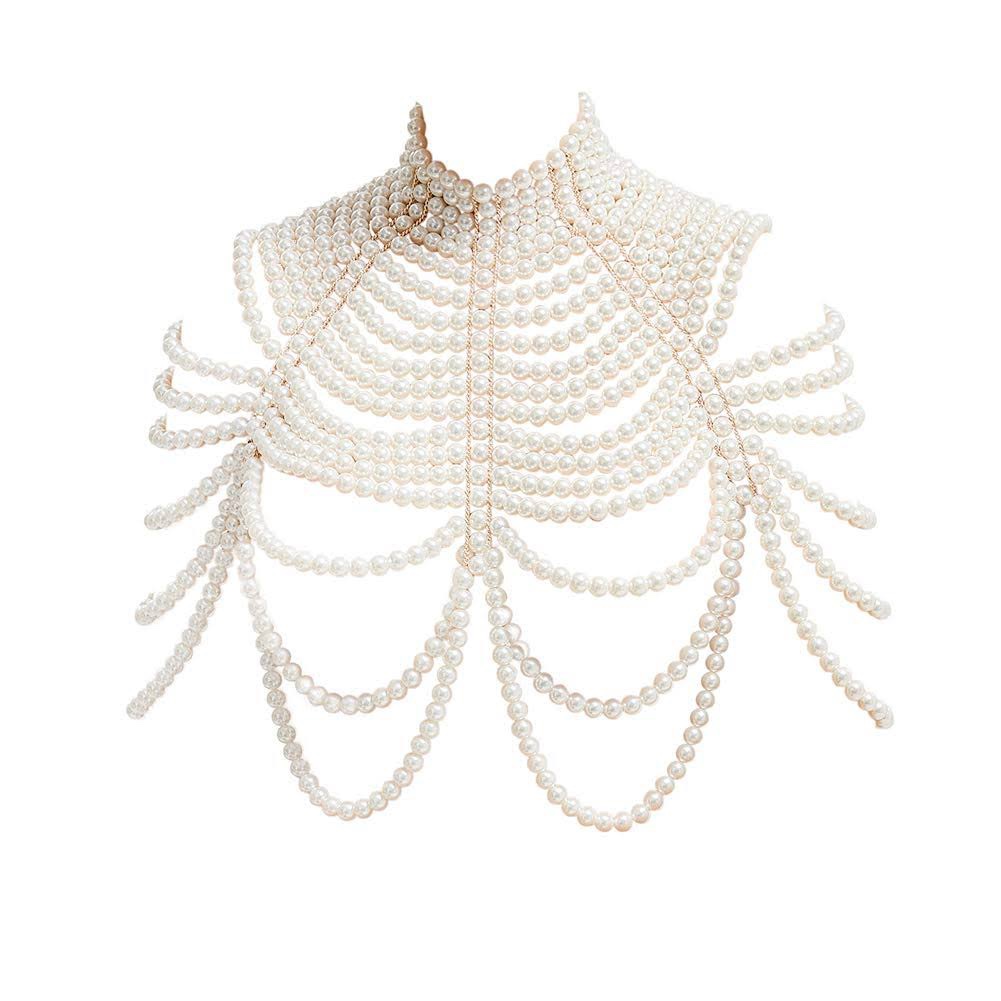
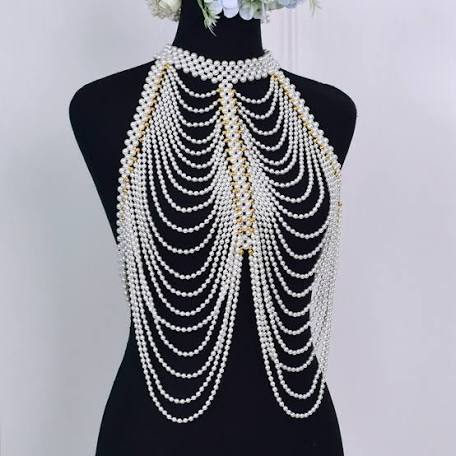
As you can see, some eye popping high end stuff. This was what Allah was referring to when Gẹ said to the wives of the prophet pbuh to ‘…not tabarrajna (display) yourselves as [was] the tabarruj (display) of the former times of ignorance…’, the times of ignorance indeed. I guess we are back to those times. 🤦🏿♂️
Now, when we read ‘…there is no blame upon them for putting aside their outer garments [but] not mutabarrijat (displaying) zeenat (adornment)…’ we know that her zeenat, not necessarily her a’wrat will be on display, but it mustn’t be on display in a manner that will qualify as buruj. And Allah continued in that verse by saying ‘…But to modestly refrain [from that] is better for them…’.
I think, she may be able to display her expensive jewelries though, hear me out. It’s the use of mim prefix to tabarrijat that’s giving me that idea; it’s a conjunctive pronoun, just as with the mim that prefixes Ahmad that gives us Muhammad, what it does is that it communicates a form of repetitive stance. So that Ahmad means the praised one, but Muhammad is not only praised, but will continue to be praised, and that he is also someone that continuously praises, it just gives any word that it comes as prefix to that excessive, extreme vibe.
Another example is Yunus, Allah referred to him in Q37 V143 as musabbiheen, from subh, as in SUBHanaLlah, but by adding the prefix mim to make musabbiheen, we know that he kept on doing the tasbih, I mean, what else will he be doing, in a fish? No time to be thinking of breakfast, lunch, dinner or when to do the dishes or run out for groceries; one will be in constant fear of what’s happening, what’s going to happen and the likes, and so he is musabbiheen, the only human so referred to in the Quran. The other time a form of that expression was used was with respect to the angels, and we know that those do the tasbih of Allah nonstop, Q37 V166 records the angels calling themselves musabbihun, and Q2 V30 records them saying that they declare the subh of Allah.
Anyway, back to mutabarrijat, it could be that they are allowed to don their expensive apparels, but they shouldn’t don it all the time. And of course, it shouldn’t be provocative, or intend to excite lustfully, remember part of the condition of this seat-ridden woman is that she is not interested in marriage. Anyway, as for the ‘ta’ after mim and before barrijat, in simple terms, it serves as an exclamation mark, just as with taqrabu in wa la taqrabu zina; by adding the ta to qarib – which means to come close, Allah is adding emphasis on the distance we have to maintain from zina, that we shouldn’t move close to it at all. If the ta wasn’t added, it would still be a prohibition, but we won’t get the alarming vibe, but with the ta, we know how serious of a prohibition it is.
And so adding that to buruj means that though buruj in itself is high end fashion or display, the ta adds another level to the display and fashion, and the mim emphasis not being one that does it constantly, and again, Allah continues the verse by saying ‘…But to modestly refrain [from that] is better for them…’.
So, obviously, because society doesn’t consider what this aged woman may display beyond her hands and face as zoHar, is why Allah has made it permissible for her to do away with her thiyab, albeit in a manner that doesn’t flaunt extravagantly her Zeenat (finery, beauty, ornament), or in a manner that’s immodest. Whether the part that this menopausal woman can display may include her arm, legs up to her knee, neck – wrinkled or not, will depend on the person and in what society they live in. And Allah knows best.
It may be that she is having a great grand child, and folks are coming over for the naming ceremony, and of course, she wants to look her best, so this one time, she does buruj, and maybe 2 more times before the year runs out, so that someone that’s counting won’t consider it excessive; but the moment it becomes an every day affair, then one is entering the realm of mutabarrijat. And Allah knows best.
By the way, did you guys notice how V59 of Q33 says to put on Jalabeeb, V58 of Q24 talks about taking off Thiyab at particular times, and V60 of Q24 says to take off Thiyab? Does 58, 59 and 60 mean something? A pointer to the age that one may qualify to take off, maybe? 🤷🏿♂️
Talking of buruj, remember the verse I quoted above about the wives of the prophet pbuh and buruj? ‘…abide in your houses and do not tabarrajna (display) yourselves as [was] the tabarruj (display) of the former times of ignorance…’, one sees that this Q33 V33 didn’t use the word hijab, this was just a don’t tabarruj, even while in the house, and as we’ve come to see, the use of ta in both use conveys how strongly they are being told not to tabarruj. You little scholar you. 🤪
As for the hijab, Q33 V53 must have been revealed after Q33 V33 because as we will see, hijab is actually a screen, a partition, not necessarily something you put on. Q33 V53 states, ‘…And when you ask [his wives] for something, ask them from behind a hijab (partition). That is purer for your hearts and their hearts…’. 2 forms of the word was used 8 times in the Quran; hijab 7 times, and mahjubun once.
Q7 V46 states that ‘And between the two there shall be a hijab (partition)…’, and Q17 V45 says that, ‘And when you recite the Qur’an, We put between you and those who do not believe in the Hereafter a concealed hijab (partition).’ From these, we see that the hijab is actually more of a structure, a partition, a barrier, screen, so that a curtain can constitute an hijab, and so can a fence, or any other material that makes sure that the form that is on its other side is not seen at all, not its shape, not its form. Even when the wives of the prophet pbuh would travel, they’d have to be in a carriage on or attached to the animal that’s being used to travel.
And as we see in V53 of Q33, the hijab was mandated for the wives of the prophet pbuh, not all Muslims women. The verse continues with more stipulations about the wives of the prophet pbuh with ‘…And it is not [conceivable or lawful] for you to harm the Messenger of Allah or to marry his wives after him, ever. Indeed, that would be in the sight of Allah an enormity.’, and we know that muslim women are allowed to remarry after their husbands die, or if they divorce. So, the ‘hijab’ only applies to the wives of the prophet pbuh, while the jilbab, thiyab and khumur applies to all muslim women.
If it wasn’t important, Allah could have used hijab for all of the instances where the woman’s veil was mentioned in all of these verses, but it is important. Allah is meticulous, the perfect grammarian, and uses the perfect words every time. Whether it be with the jilbab, khumur, thiyab, or the hijab, each of them were perfectly used, carefully placed to convey the message clearly and effectively. May Allah make us understand Gẹs words. Amin.
Another reason why making a distinction between the hijab, and the khumur, and the other words we will be looking at is important is because it was a practice of some early Muslims in the yoruba tribe of Nigeria, perhaps, they still exist in some remote parts in the yoruba-sphere or around the world, wherein wives, once married, are not seen again! Not in the market, not at family gatherings, not by other women, not anywhere, they are even shielded from their relatives too in the name of the ‘hijab’; whereas hijab, as we’ve seen, was only mentioned with respect to the wives of the prophet pbuh. And in the verse, we see that Allah expressly stated that they should not remarry after the prophet pbuh, but a muslim woman can remarry if she divorces her husband or if the husband dies, so the same rules doesn’t and shouldn’t apply, sorry.
So, now, you see how precise God is in Gẹs wordings. You’ll also notice that Q33 V53 which has the word ‘Hijab’ in it is just a couple of verses before V59 which has the ‘Jalabeeb’ in it; so Allah could have totally repeated Hijab again in V59, but Gẹ chose to use the word Jalabeeb.
In fact, since we are here, we might as well, right? So, other than Jalabeeb, Khumur, Hijab, and Thiyab that were used as cloths in the Quran, I have found 6 more words that were used to refer to cloth, and they are libas, sarabeel, mudathir, sabaga, kiswa, and qamees, and as you must have guessed, each has its own nuance. So, briefly, so as not to make this extremely cumbersome, let’s delve into them too, shall we? 😁
Libas’s root alphabets are lam, ba and sin, it is said of something that mixes with the other, so perfectly mixed, that you cannot differentiate it from the other; blends perfectly; becomes one with it; hides the other; and so people that look at it are in doubt as to which is which, this is libas.
Q2 V42 says not to ‘…talbisu (mix) truth with falsehood…’. Q6 V9 says ‘if We had made him [the Messenger] an angel, We would still have made him [in the shape of] a human being, and labasna (confused) for them the thing which they are now yalbisu (confusing) for themselves’. Q50 V15 says ‘…they are in labsin (doubt) concerning a new creation.’
And so when Q2 V187 says about husbands and wives being libas for each other when Gẹ said ‘…They are libas (clothing) for you and you are libas (clothing) for them…’, which some have translated to ‘blanket’; in whatever form one finds it as a piece of cloth; we know now that it is used when having one or all that have been written above in mind, and more. As part of what it can mean here is that a couple should be one, so much so that people aren’t able to split them apart. They should hide their ‘bearable’ faults from the world just as cloths hide one’s bodily faults, and so on and so forth. And the peace of mind from trusting the other to protect you, and not slander you, or tell your secrets, is also part of its meaning.
So when we see in Q21 V80 that ‘And We taught him the fashioning of labus (coats of armor) to protect you from your enemy in battle…’, you now know why Allah chose to use libas here rather than thiyab or julub, right? Since libas means to hide also, one is able to hide one’s self behind the armor as a means of protection, one is able to use it to camouflage. Hehe! I love the Quran. 🥰 🥰🥰 Allah ends that verse with ‘…So will you then be grateful?’
Now let’s move to Sarabeel, its root alphabets are sin, ra, ba, and lam, one of the very few words that have 4 root alphabets, all others have 3 alphabets. But it made up for its lack of 3-ness in the Quran, where it appeared only 3 times; Q16 V81 twice, and in Q14 V50 once.
As for its meaning, let’s look into those verses; Q16 V81 says ‘And Allah has made for you, from that which He has created, shadows and has made for you from the mountains, shelters and has made for you sarabeel (garments) which protect you from the heat and sarabeel (garments) which protect you from your [enemy in] battle. Thus does He complete His favor upon you that you might submit [to Him].’
Before quoting Q14 V50, what you’ll realize from Q16 V81 right away is that it also ‘protects in battle’, and if you remember, I quoted Q21 V80 that says about libas that it ‘protect you from your enemy in battle…’, so how do we reconcile these translations? The answer is in the nature of their being; while libas is able to make one evade attack with its blending qualities, sarabeel aims at actual protection from harm, and so a better translation would be ‘coats of mail’ or ‘armor’ as some other translators have translated it. So, whether it’s the cloths that protects you from heat (I didn’t know those exists, but apparently, some reduce up to 95% of radiant heat), or the body armors that actually protects one’s physical body, they both have that quality of protecting the body from harm, unlike libas in our example that’s more of camouflaging, helping one evade attackers and the likes.
As for Q14 V50, it says about the people of hell that ‘Their sarabeel (garments) of qatira (liquid pitch) and their faces covered by the Fire’; qatira has been translated to mean tar, trickling tar, molten pitch, liquid pitch, and from what we know of sarabeel being ‘protecting from harm’, that tells us that their ‘armor’ will be harmful in itself, but in a way, will be keeping the body from being engulfed in fire as their faces will be engulfed. May Allah protect us, our loved ones, and the entire muslim ummah from the first to the last, from being an inmate of hell. Amin. Tar, mehn, that’s the stuff used to ‘tar’ roads, that stuff absorbs heat, enough heat to burn one’s sole on a hot day, and that’s what the cloths of the inhabitants of hell will be made from. May Allah protect us. Amin.
Now, let’s move to mudathir, its root alphabets are dal, tha and ra, and it is said of something being enormous, enormous wealth, unbounded riches. A tree is said to be dathir when the tree brings out new leaves and branches. Dathir is also said of when things accumulates, layer upon layer; and that’s why you find that it is translated to ‘wrap’ in some translations of Q74 V1, the only place that it appears in the Quran. And from what we understand of the word now, we can tell that it must have been a lot of cloths that the prophet pbuh wrapped himself in, layers upon layers, trying to shield himself from what had ‘attacked’ him. And from the Mim prefixing it, we know that he pbuh must have been so covering continuously and repeatedly.
Sabaga, its root alphabets are sin, ba and gain, and 2 forms occured once each, asbaga, and sabigat. And with respect to garments, it means to be long and overflowing; ease of living, otherwise it means to be abundant, as we see in Q31 V20 that says that ‘…and He has asbaga (lavished) on you His bounties, apparent and hidden…’, and with respect to cloths, Q34 V11 says that “[saying, to him] ‘Make sabigat (full-length coats of mail), and measure well the links…’, and knowing that it also means to be long, overflowing, put together with full-length, we see how it contrasts with dathir that its abundance is one that’s built on being ‘layered’ unlike sabag that its abundance has to do with its ‘overflowing length’ qualities.
As for Kiswa, its root alphabets are kef, sin and waw, and kiswa is said of clothing, like the verb, the idea of being clothed. Q4 V5 talks about not giving your money to someone you think won’t know how to spend it, but that one should still ‘clothe them and speak to them words of appropriate kindness.’ Q5 V89 talks about clothing 10 people as a means of expiation for an unfulfilled oath. And in Q23 V14, Allah talks about clothing the bones with flesh, so that our skin is a kind of kiswa too. Anyway, those are just some few examples of how kiswa was used in the Quran, and we see that it has that verb vibe, rather than a noun nuance; no specifics as to what it should cover, when it should be worn, and the likes.
Lastly now, let’s move on to Qamees, it only appeared in this one form 6 times in the Quran, and all 6 times was with respect to Yusuf. Qamees is said to mean a shirt, garment, inner garment, dress, gown, to wear a shirt, to quake, to be jumpy, to be agile, to gallop, to jump, to hop, to move. Qamees is said when the waves rock the boat, it is also said of a horse when it raises its forelegs together and then hits them together on the ground, it is also said of the animal which starts jumping with the rider on its back, and of an animal that jumps too much, and lastly, it is said of a camel disease which makes the camel restless and it can not stand still.
I hope that paints a picture something not being still, something that moves back and forth, up and down and the likes. It is interesting to note that, somehow, the 6 times that the qamees was mentioned in the Quran, they seem to be on the move in one form or another; Q12 V18 talks about when Yusuf’s siblings brought his qamees to their father with the wolf’s blood; V25 talks about the wife of the chief tearing his qamees; V26 talks about if the qamees was torn from the front, and V27 talks about it being torn from the back; V28 talks about the husband examining the qamees with his eyes, and V93 talks about Yusuf giving his qamees out.
So we see that it was in the hands of his siblings, and then in the hands of the woman that tore it, and then in the hands of the husband, and then in his hands. We don’t know for sure in whose hands it was in V26 and V27, but Allah gave it that back and forth quality by mentioning the front of the shirt in V26, and its back in V27; thereby emphasizing why qamees was used to refer to the shirt, because the shirt kept moving, like the waves to the boat, like the horse to its rider, the restless animal, and so on and so forth. None of the other words we’ve looked at would have been appropriately fitting.
In fact, the theme of restlessness, back and forth-ness, and up and down-ness wasn’t limited to the physical touch of the cloth, but also in how it was being referred to in the Quran. V18 has it as QameesiHi, V25 has it as QameesoHu, V26 and V27 has it as QameesuHu, V28 has it as QameesoHu and V93 has it as Qameesiy. So that it appeared differently when it was with his siblings in V18; it appeared the same way when it was with the husband and the wife in V25 and V28, differently, but the same way when it was being adjudicated upon in V26 and V27; and ultimately, differently, when he was giving it out. Now, we see the words too hopping, jumping, moving, just as the shirt has been moving, hopping and jumping. Allahu Akbar! Did I mention how much I love Allah’s words already? Hehe! 🥰😘
In fact, with the way Classical Arabic works, words that can mean cloths can be endless; for instance, a form of ‘Salam’ can be created to mean a shirt, and what we will deduce from that is that the cloth gives peace, or it’s a cloth that’s meant to signify peace. I hope you understand how these deductions work now, and we are able to appreciate how specific Allah meant for the words Gẹ used to refer to the veil in the Quran. If we don’t take the actual words into consideration, we’ll have to resort to saying one verse abrogated the other, as some scholars have said, or start applying what was meant for the wives of the prophet pbuh to all muslim women, as pretty much most of the muslim world is doing now. I pray Allah makes you understand this deeper than I have understood it, and make it sow a seed of love for Allah’s words in your heart. Amin.
And I will end this with what Allah ended 24 V31 with when Gẹ said to all believers, ‘And turn to Allah in repentance, all of you, O believers, that you might succeed.’, because Gẹ knows that from V30 that tells the men to lower their gaze, to V31 that says the same to women, and adds how the woman should dress; we will falter in carrying out these injunctions, so Gẹ tells us to repent, and that we should always remember to repent to Allah SWT. May Allah accept our repentance, and grant us all we need to follow Gẹs injunctions. Amin.
I intend to end this piece by highlighting the fact that I am a male, and I cannot begin to understand the complexities surrounding the veil; each person has a unique situation, and they should pace themselves as they deem best in accordance to their sincerity to Allah, and not the pressure society puts on them. You alone will stand before Allah, let your sincerity come from within. 👍🏿
I was inspired to write this exegesis after reading a book of fiction by Muti’ah Badruddeen titled Rekiya and Z. The author is a fully veiled medical doctor that practices in Saudi Arabia. And I couldn’t help but notice the dynamics of the veil in the said book.
The theme of the veil ranged from when it is worn, how it is worn, why it is worn, where it is worn, what it constitutes, and the list goes on. In fact, the book in one instance looked into how the architecture of home fencing can actually aid adherence to veiling even in one’s home. I thought that was interesting. 😁
And so I thought to delve into what the verses on the subject says in light of the classical arabic that was spoken at the time as opposed to standard modern arabic as it is spoken and understood today. And hopefully, the conversation continues with this.
Each society can use this as a framework to create its own khumur, for instance. Just as a Nigerian can create a khumur from ankara material, an American can create khumur from suit material, a Ghanian can create khumur from kente material, and cultures around the world can create their khumurs in a way that satisfies the terms of the verses, and yet, autochthonous in its entirety.
Assallamu Alaikum Warahmatullahi Wabarakatuh
 themarhaminstitute
2 thoughts on “the veil in islam, all you need to know.”